Shear strength reduction - Slope stability
 This page is based on a Jupyter notebook.



import os…
(click to toggle)
import os
from pathlib import Path

import numpy as np
import ogstools as ot
import pyvista as pv
import slope_postprocessing as sp
from slope_mesh_stage import CaseSpec, MeshStage
from slope_runner import MultiCaseRunner
ot.plot.setup.show_region_bounds = False…
(click to toggle)
ot.plot.setup.show_region_bounds = False

out_dir = Path(os.environ.get("OGS_TESTRUNNER_OUT_DIR", "_out"))
out_dir.mkdir(parents=True, exist_ok=True)Shear strength reduction ($\varphi$–$c$ reduction)
We compute the slope factor of safety using the shear strength reduction (SSR) method, in which the Mohr–Coulomb shear strength is reduced by a trial factor ($F$) until static equilibrium can no longer be achieved (typically observed as non-convergence and/or formation of a continuous plastic shear band). In the classical formulation, reduction is applied as \begin{equation} c_{\text{trial}}=\frac{c_0}{F}, \qquad \tan\varphi_{\text{trial}}=\frac{\tan\varphi_0}{F}, \qquad \left(\Rightarrow\ \varphi_{\text{trial}}=\arctan\left(\frac{\tan\varphi_0}{F}\right)\right), \end{equation} and the limiting value of ($F$) at failure is interpreted as the factor of safety.
Staged procedure in OpenGeoSys
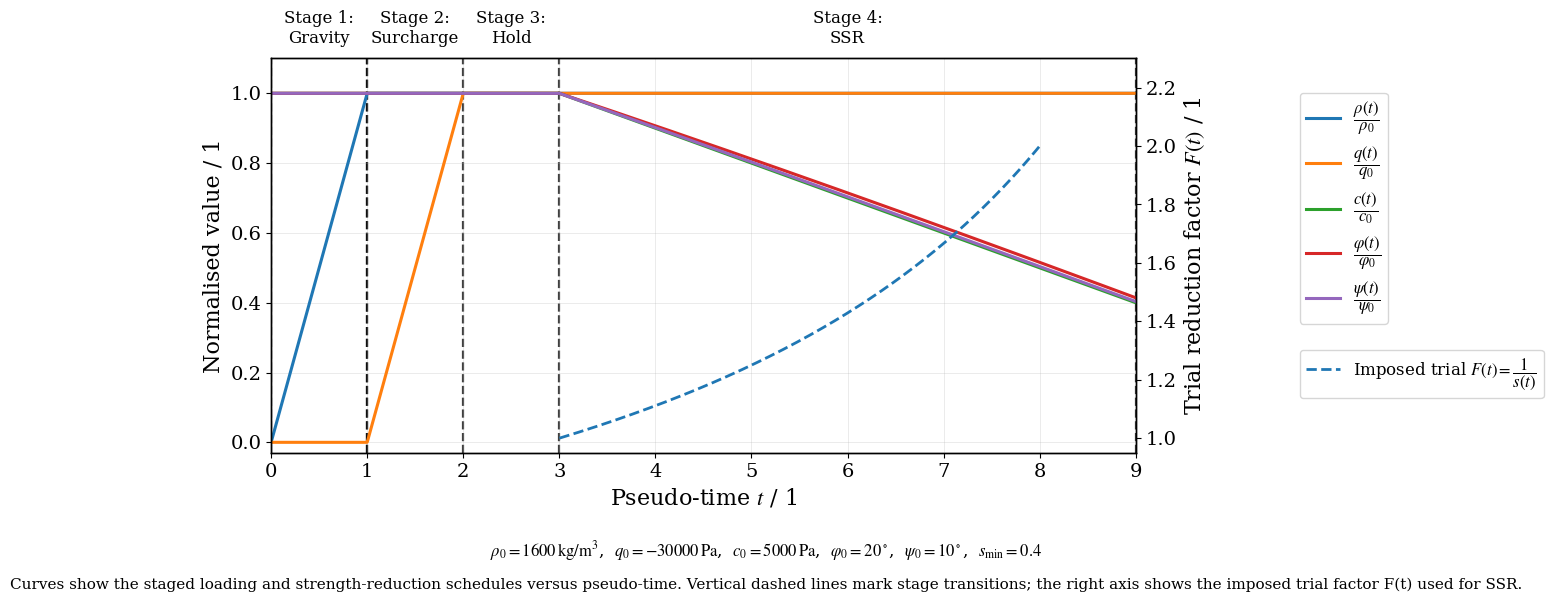
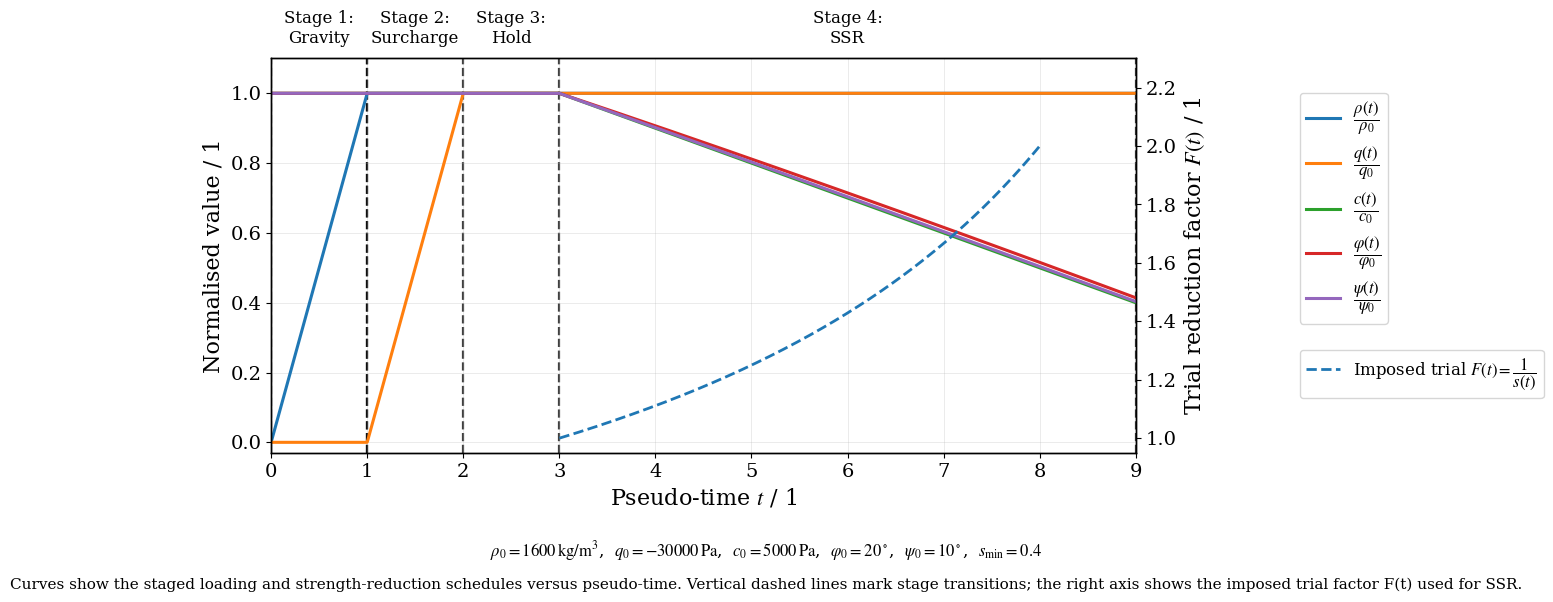
To avoid numerical artefacts from an unrealistic initial stress state, loading and reduction are applied in stages using pseudo-time. This staged procedure follows the OGS slope-stability workflow where gravity and surface load are ramped first and strength reduction starts later.
Stage 1 — Gravity ramp ($t=0\rightarrow1$) Gravity is activated by ramping the solid density from 0 to its target value using a time-dependent function, \begin{equation} \rho(t)=\rho_0\cdot r_\rho(t), \qquad r_\rho(t)=\max\left(0,\ \min\left(1,\ \frac{t}{t_\rho}\right)\right), \qquad \rho_0=1600~\mathrm{kg/m^3}, \end{equation} with $t_\rho=1$ and fixed body force $\mathbf{b}=(0,-9.81)\ \mathrm{m/s^2}$.
Stage 2 — Surcharge (top load) ramp ($t=1\rightarrow2$) A distributed top load is applied using a time-dependent ramp, \begin{equation} q(t)=q_0\cdot r_q(t), \qquad r_q(t)=\max\left(0,\ \min\left(1,\ \frac{t-t_{q0}}{t_{q1}-t_{q0}}\right)\right), \qquad q_0=-30~\mathrm{kPa}, \end{equation} with $t_{q0}=1$ and $t_{q1}=2$. Thus $q=0$ for $t\le 1$ and reaches full magnitude at $t=2$.
Stage 3 — Hold / equilibration ($t=2\rightarrow 3$) After gravity and surcharge are fully applied, the model is held for 1 unit of pseudo-time with no strength reduction before weakening starts.
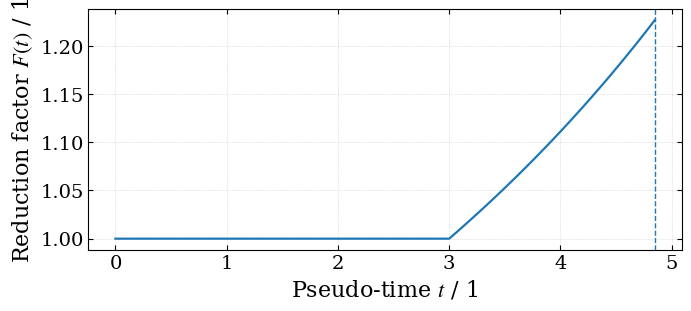
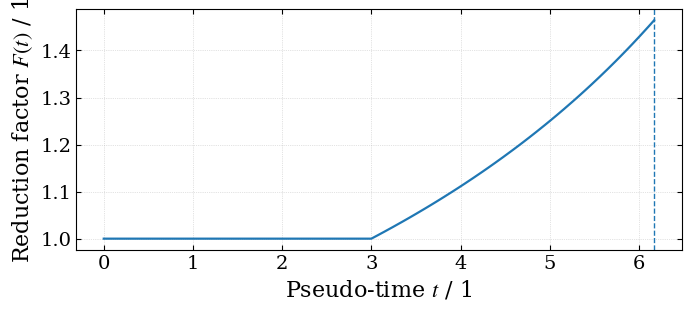
Stage 4 — Strength reduction (SSR) ($t\ge 3$) Strength reduction is prescribed as a time-dependent multiplier $s(t)\in[s_{\min},1]$, and the trial factor is defined as \begin{equation} F(t)=\frac{1}{s(t)}. \end{equation} We use a linear decrease (clipped to $[s_{\min},1]$) during the SSR interval $t\in[t_0,t_1]$, \begin{equation} s(t)= \left( s_{\min}, \quad \left( 1, \quad 1-(1-s_{\min})\frac{t-t_0}{t_1-t_0} \right)\right), \qquad t_0=3,\quad t_1=9,\quad s_{\min}=0.4. \end{equation}
-
Cohesion reduction Cohesion is reduced linearly as \begin{equation} c(t)=s(t)\cdot c_0, \qquad c_0=5000~\mathrm{Pa}. \end{equation}
-
Friction and dilatancy reduction (SSR-consistent) In SSR the reduction is defined on $\tan\varphi$, i.e. \begin{equation} \tan\varphi(t)=\frac{\tan\varphi_0}{F(t)}=\tan\varphi_0\cdot s(t), \qquad \Rightarrow\quad \varphi(t)=\arctan\big(\tan\varphi_0\cdot s(t)\big). \end{equation} An analogous relation is used for the dilatancy angle ($\psi$): \begin{equation} \psi(t)=\arctan\big(\tan\psi_0\cdot s(t)\big). \end{equation}
Failure is identified by loss of numerical convergence, corroborated by the formation of a continuous plastic shear band.
Input data
# ----------------------------…
(click to toggle)
# ----------------------------
# Project basename and template
# ----------------------------
BASENAME = "slope"
TEMPLATE_PRJ = Path(f"{BASENAME}.prj")
SRC_MESH_DIR = Path("mesh")

# ----------------------------
# MASTER: global configuration
# ----------------------------
MASTER = {
    "mesh_name": "slope_case",
    "geometry": {
        # Domain size / slope geometry [m]
        "L_bottom": 18.0,
        "H_top": 6.5,
        "H_bench": 2.0,
        "x_toe": 3.0,
        "x_crest": 12.0,
        # x-coordinates of top polyline "break points" [m]
        # (order matters)
        "top_breaks": [18.0, 15.5, 12.5, 12.0],
        # Target mesh size [m]
        "h": 0.25,
    },
    "mesh": {
        "algo_2d": 5,
        "recombine": False,  # True -> quads where possible
        "generate_mesh": True,
    },
    "physics": {
        # Body force [m/s^2] (gravity in -y)
        "specific_body_force": [0.0, -9.81]
    },
    "material": {
        "parameters": {
            "scalar": {
                # Elasticity (constants)
                "YoungModulus": 26e5,
                "PoissonRatio": 0.3,
                # Baseline strength constants (the only strength numbers user edits)
                "cohesion_rs0": 5000,  # [Pa]
                "FrictionAngle_rs0": 20,  # [deg]
                "DilatancyAngle_rs0": 10,  # [deg]
                "TransitionAngle": 27,  # [deg]
                "TensionCutOffParameter_rs0": 300,  # [Pa]
                # Baseline loads/constants
                "rho_sr0": 1600,
                "top_load0": -30000,
                "dirichlet0": 0,
            },
            "vector": {
                "displacement0": [0.0, 0.0],
                "T_ref": [293.15],
            },
        },
    },
    # staging schedule (user edits times only)
    "stages": {
        "rho_t1": 1.0,  # density ramp 0->1 on [0, rho_t1]
        "load_t0": 1.0,  # load starts ramping at t=load_t0
        "load_t1": 2.0,  # load reaches full at t=load_t1
    },
    # SSR schedule (user edits only these 3)
    "ssr": {
        "t0": 3.0,  # SSR starts
        "t1": 9.0,  # SSR reaches minimum
        "smin": 0.4,  # minimum strength multiplier s(t)=1/F(t)
    },
    "time_stepping": {
        # Time window
        "t_initial": 0.0,
        "t_end": 9.0,
        # dt controls
        "initial_dt": 0.1,
        "minimum_dt": 1e-3,
        "maximum_dt": 0.5,
        "number_iterations": "1 8 13 20",
        "multiplier": "1.2 1.0 0.9 0.5",
    },
    "output": {"prefix": "slope", "suffix": "_ts_{:timestep}_t_{:time}"},
}

# ----------------------------
# Load configurations
# ----------------------------
# These dictionaries are used by your geometry/BC generation logic.

LOAD_ALL = {
    "mode": "all",  # apply load on the default/top region (your code decides which part of the top is “eligible”)
    "L_load": 3.0,  # [m] patch length along the top boundary (used by edge/crest modes; may be ignored in "all")
    "clamp": True,
    "L_top_1": 2.5,  # [m] length of top segment 1 (only used when mode="top_segments")
    "L_top_2": 3.0,  # [m] length of top segment 2
    "L_top_3": 0.5,  # [m] length of top segment 3
    "loaded_zones": [
        2
    ],  # segment indices to load (only used when mode="top_segments"), e.g. [2]=only segment 2
}

LOAD_RIGHT = {
    **LOAD_ALL,
    "mode": "from_right_edge",  # load a patch of length L_load anchored at the right end of the top boundary
    "L_load": 3.0,
}

LOAD_CREST = {
    **LOAD_ALL,
    "mode": "from_slope_crest",  # load a patch of length L_load anchored at the slope crest (near x_crest)
    "L_load": 3.0,
}

LOAD_SEG2 = {
    **LOAD_ALL,
    "mode": "top_segments",  # split top into 3 segments (L_top_1/2/3) and load only 'loaded_zones'
    "L_top_1": 2.5,
    "L_top_2": 3.0,
    "L_top_3": 0.5,
    "loaded_zones": [2],
}


# Reference mesh size convenience
h_ref = float(MASTER["geometry"]["h"])

# ----------------------------
# Case list
# ----------------------------
# Notes on mesh handling:
# - Case 1 ("reference") uses a pre-existing mesh from the local ./mesh folder.
#   This avoids CI/test failures caused by small, OS-dependent differences in Gmsh mesh generation
#   (e.g., Linux vs macOS).
# - Case 2 ("load_right") generates a new mesh into _out/<case>/mesh to test the full workflow
#   (mesh generation + simulation) for a different loading configuration.
cases = [
    CaseSpec(
        label="reference",
        h=h_ref,
        element_order=2,
        nonlinear_reltol=1e-14,
        minimum_dt=1e-4,
        load=LOAD_ALL,
        load_tag="all",
        mesh_mode="use",
        src_mesh_dir=SRC_MESH_DIR,
        mesh_dir=SRC_MESH_DIR,
    ),
    CaseSpec(
        label="load_right",
        h=h_ref,
        element_order=2,
        nonlinear_reltol=1e-14,
        minimum_dt=1e-4,
        load=LOAD_RIGHT,
        load_tag="right",
        mesh_mode="generate",  # generate a new mesh into _out/<case>/mesh
        regenerate=True,  # force rebuild
        plot_mesh=True,
    ),
]Mesh generation and pre-processing
mesh_stage = MeshStage(out_root=out_dir)…
(click to toggle)
mesh_stage = MeshStage(out_root=out_dir)
mesh_results = mesh_stage.build_all(
    basename="slope",
    template_prj=TEMPLATE_PRJ,
    master=MASTER,
    cases=cases,
)[MESH-CASE] slope__ord-quad__h-0p25__dtmin-1e-04__tol-1e-14__load-all__reference
mesh_mode = use
[OK] slope__ord-quad__h-0p25__dtmin-1e-04__tol-1e-14__load-all__reference
[MESH-CASE] slope__ord-quad__h-0p25__dtmin-1e-04__tol-1e-14__load-right__load_right
mesh_mode = generate
info: Reordering nodes...
info: Method: Reversing order of nodes unless it is considered correct by the OGS6 standard, i.e. such that det(J) > 0, where J is the Jacobian of the global-to-local coordinate transformation.
info: Corrected 0 elements.
info: VTU file written.
info: Create a quadratic order mesh
info: Save the new mesh into a file
info: Create a quadratic order mesh
info: Save the new mesh into a file
info: Create a quadratic order mesh
info: Save the new mesh into a file
info: Create a quadratic order mesh
info: Save the new mesh into a file
info: Create a quadratic order mesh
info: Save the new mesh into a file
info: Create a quadratic order mesh
info: Save the new mesh into a file
info: Create a quadratic order mesh
info: Save the new mesh into a file
info: Create a quadratic order mesh
info: Save the new mesh into a file
info: Create a quadratic order mesh
info: Save the new mesh into a file
info: Mesh reading time: 0.00582847 s
info: MeshNodeSearcher construction time: 0.00041737 s
info: identifySubdomainMesh(): identifySubdomainMeshNodes took 7.291e-06 s
info: identifySubdomainMesh(): identifySubdomainMeshElements took 0.000537332 s
info: There is already a 'bulk_element_ids' property present in the subdomain mesh 'bench' and it is equal to the newly computed values.
info: identifySubdomainMesh(): identifySubdomainMeshNodes took 1.4973e-05 s
info: identifySubdomainMesh(): identifySubdomainMeshElements took 0.000301726 s
info: There is already a 'bulk_element_ids' property present in the subdomain mesh 'bottom' and it is equal to the newly computed values.
info: identifySubdomainMesh(): identifySubdomainMeshNodes took 2.714e-06 s
info: identifySubdomainMesh(): identifySubdomainMeshElements took 0.000274235 s
info: There is already a 'bulk_element_ids' property present in the subdomain mesh 'left' and it is equal to the newly computed values.
info: identifySubdomainMesh(): identifySubdomainMeshNodes took 8.884e-06 s
info: identifySubdomainMesh(): identifySubdomainMeshElements took 0.000281185 s
info: There is already a 'bulk_element_ids' property present in the subdomain mesh 'right' and it is equal to the newly computed values.
info: identifySubdomainMesh(): identifySubdomainMeshNodes took 8.473e-06 s
info: identifySubdomainMesh(): identifySubdomainMeshElements took 0.000275146 s
info: There is already a 'bulk_element_ids' property present in the subdomain mesh 'slope' and it is equal to the newly computed values.
info: identifySubdomainMesh(): identifySubdomainMeshNodes took 2.834e-06 s
info: identifySubdomainMesh(): identifySubdomainMeshElements took 0.000272161 s
info: There is already a 'bulk_element_ids' property present in the subdomain mesh 'top_load' and it is equal to the newly computed values.
info: identifySubdomains time: 0.00245187 s
info: writing time: 0.00371797 s
info: Entire run time: 0.0128952 s


info: Reordering nodes...
info: Method: Reversing order of nodes unless it is considered correct by the OGS6 standard, i.e. such that det(J) > 0, where J is the Jacobian of the global-to-local coordinate transformation.
info: Corrected 0 elements.
info: VTU file written.
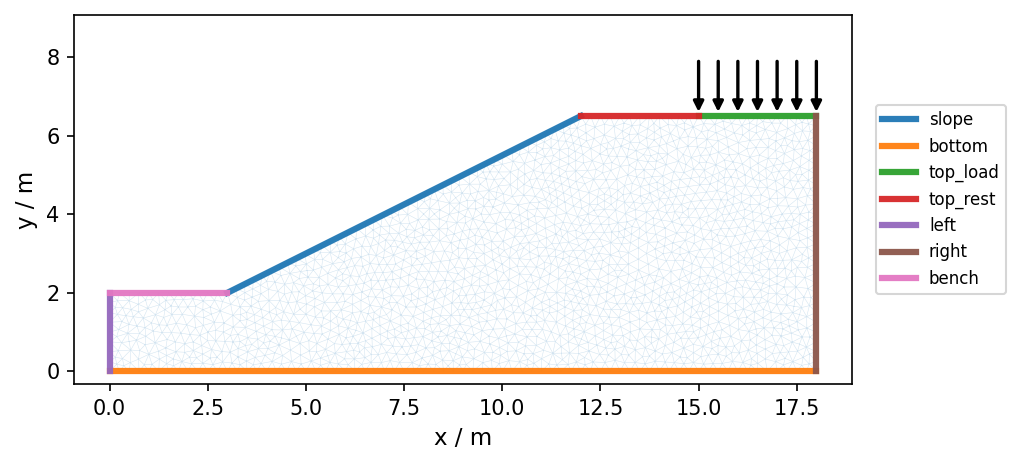
[PLOT] saved -> /var/lib/gitlab-runner/builds/t1_R7hwLX/1/ogs/build/release-all/Tests/Data/Mechanics/MohrCoulombAbboSloan/FOS_SlopeStability/FOS_SlopeStability/slope__ord-quad__h-0p25__dtmin-1e-04__tol-1e-14__load-right__load_right/mesh/mesh.png
[OK] slope__ord-quad__h-0p25__dtmin-1e-04__tol-1e-14__load-right__load_right
Prepare the prj file and run the simulations
runner = MultiCaseRunner(out_root=out_dir)…
(click to toggle)
runner = MultiCaseRunner(out_root=out_dir)

ogs_results = runner.run_all(
    basename="slope",
    template_prj=TEMPLATE_PRJ,
    master=MASTER,
    cases=cases,
)[RUN] slope__ord-quad__h-0p25__dtmin-1e-04__tol-1e-14__load-all__reference
mesh_dir = mesh
 ogs -m mesh -o /var/lib/gitlab-runner/builds/t1_R7hwLX/1/ogs/build/release-all/Tests/Data/Mechanics/MohrCoulombAbboSloan/FOS_SlopeStability/FOS_SlopeStability/slope__ord-quad__h-0p25__dtmin-1e-04__tol-1e-14__load-all__reference/results /var/lib/gitlab-runner/builds/t1_R7hwLX/1/ogs/build/release-all/Tests/Data/Mechanics/MohrCoulombAbboSloan/FOS_SlopeStability/FOS_SlopeStability/slope__ord-quad__h-0p25__dtmin-1e-04__tol-1e-14__load-all__reference/project.prj
['ogs', '-m', 'mesh', '-o', '/var/lib/gitlab-runner/builds/t1_R7hwLX/1/ogs/build/release-all/Tests/Data/Mechanics/MohrCoulombAbboSloan/FOS_SlopeStability/FOS_SlopeStability/slope__ord-quad__h-0p25__dtmin-1e-04__tol-1e-14__load-all__reference/results', '/var/lib/gitlab-runner/builds/t1_R7hwLX/1/ogs/build/release-all/Tests/Data/Mechanics/MohrCoulombAbboSloan/FOS_SlopeStability/FOS_SlopeStability/slope__ord-quad__h-0p25__dtmin-1e-04__tol-1e-14__load-all__reference/project.prj']
[OK] slope__ord-quad__h-0p25__dtmin-1e-04__tol-1e-14__load-all__reference

[RUN] slope__ord-quad__h-0p25__dtmin-1e-04__tol-1e-14__load-right__load_right
      mesh_dir = /var/lib/gitlab-runner/builds/t1_R7hwLX/1/ogs/build/release-all/Tests/Data/Mechanics/MohrCoulombAbboSloan/FOS_SlopeStability/FOS_SlopeStability/slope__ord-quad__h-0p25__dtmin-1e-04__tol-1e-14__load-right__load_right/mesh
 ogs -m /var/lib/gitlab-runner/builds/t1_R7hwLX/1/ogs/build/release-all/Tests/Data/Mechanics/MohrCoulombAbboSloan/FOS_SlopeStability/FOS_SlopeStability/slope__ord-quad__h-0p25__dtmin-1e-04__tol-1e-14__load-right__load_right/mesh -o /var/lib/gitlab-runner/builds/t1_R7hwLX/1/ogs/build/release-all/Tests/Data/Mechanics/MohrCoulombAbboSloan/FOS_SlopeStability/FOS_SlopeStability/slope__ord-quad__h-0p25__dtmin-1e-04__tol-1e-14__load-right__load_right/results /var/lib/gitlab-runner/builds/t1_R7hwLX/1/ogs/build/release-all/Tests/Data/Mechanics/MohrCoulombAbboSloan/FOS_SlopeStability/FOS_SlopeStability/slope__ord-quad__h-0p25__dtmin-1e-04__tol-1e-14__load-right__load_right/project.prj
['ogs', '-m', '/var/lib/gitlab-runner/builds/t1_R7hwLX/1/ogs/build/release-all/Tests/Data/Mechanics/MohrCoulombAbboSloan/FOS_SlopeStability/FOS_SlopeStability/slope__ord-quad__h-0p25__dtmin-1e-04__tol-1e-14__load-right__load_right/mesh', '-o', '/var/lib/gitlab-runner/builds/t1_R7hwLX/1/ogs/build/release-all/Tests/Data/Mechanics/MohrCoulombAbboSloan/FOS_SlopeStability/FOS_SlopeStability/slope__ord-quad__h-0p25__dtmin-1e-04__tol-1e-14__load-right__load_right/results', '/var/lib/gitlab-runner/builds/t1_R7hwLX/1/ogs/build/release-all/Tests/Data/Mechanics/MohrCoulombAbboSloan/FOS_SlopeStability/FOS_SlopeStability/slope__ord-quad__h-0p25__dtmin-1e-04__tol-1e-14__load-right__load_right/project.prj']
[OK] slope__ord-quad__h-0p25__dtmin-1e-04__tol-1e-14__load-right__load_right
Post-processing
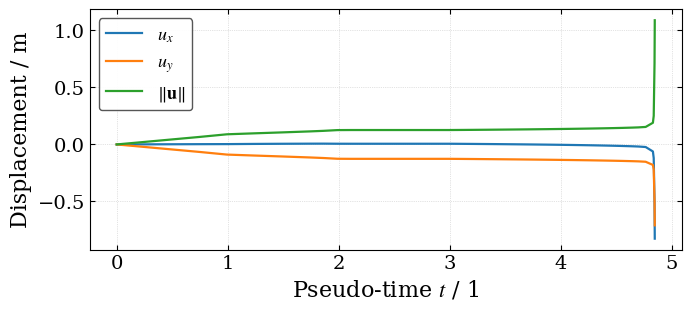
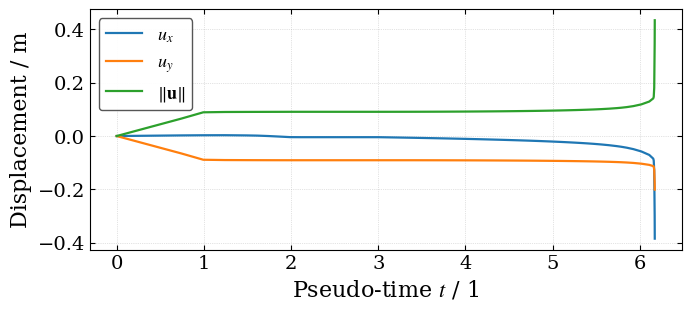
Plots: factor of safety vs pseudo-time, slope crown displacement vs time, and field maps.
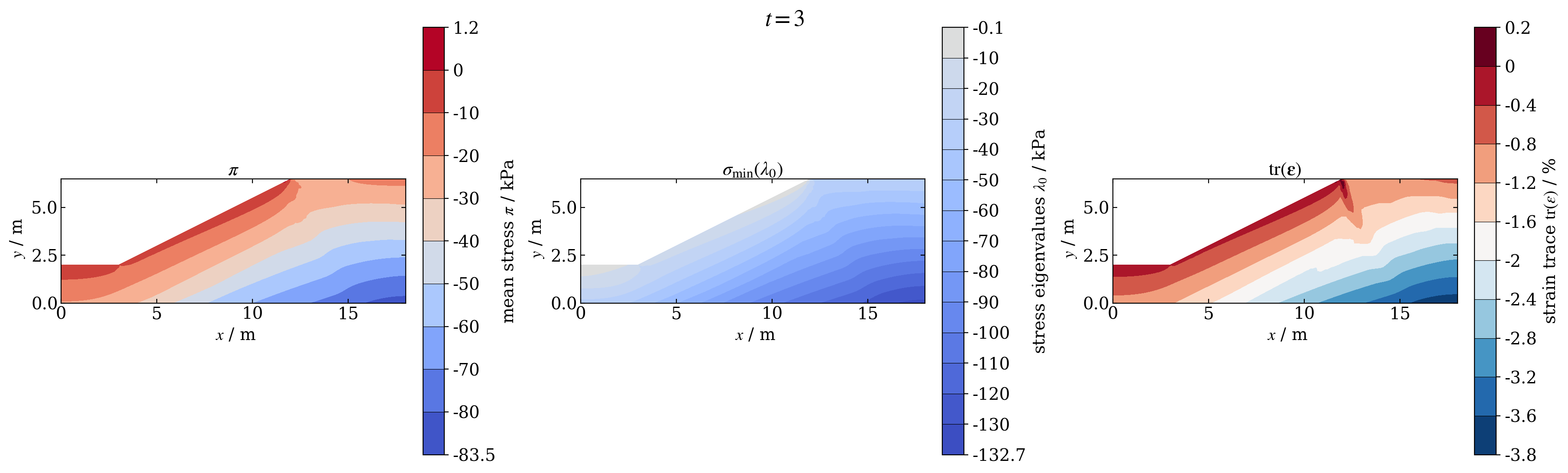
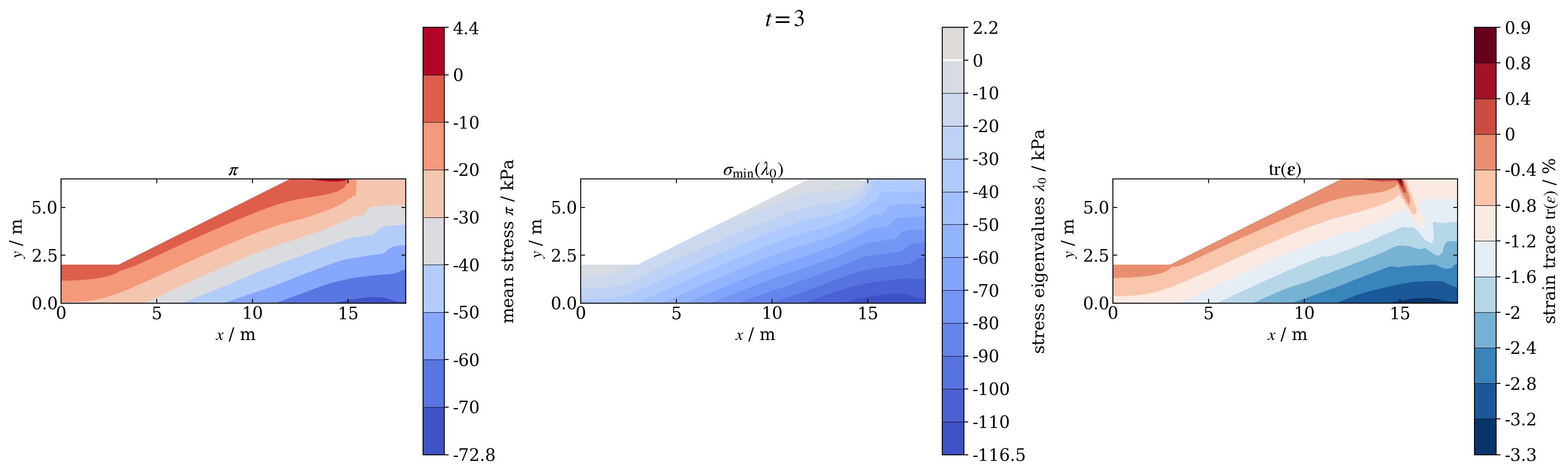
The first row of profiles shows baseline fields at the at end of Stage 3 (hold/equilibration, ($t=3$)): mean stress ($\pi$), minimum principal stress ($\sigma_{\min}$), and trace strain ($\mathrm{tr}(\boldsymbol{\varepsilon})$).
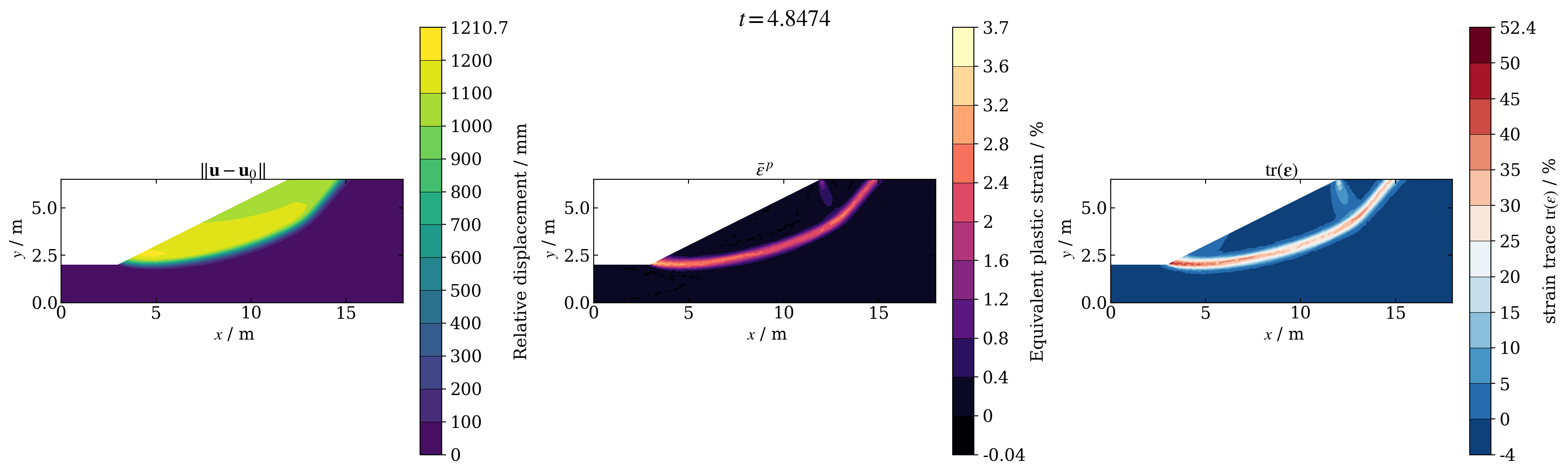
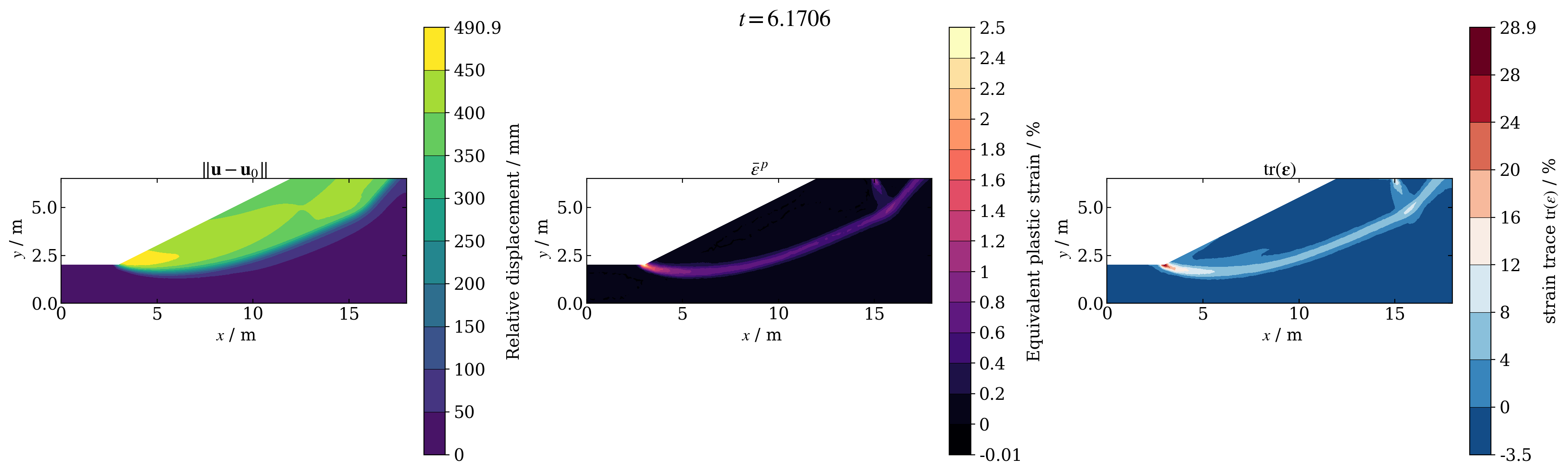
The second row shows end-of-SSR fields ($t=t_{\mathrm{end}}$): relative displacement magnitude ($\|\mathbf{u}-\mathbf{u}_0\|$), equivalent plastic strain ($\bar{\varepsilon}^{\,p}$), and trace strain ($\mathrm{tr}(\boldsymbol{\varepsilon})$).
sp.configure_plots(ogs_fontsize=16)…
(click to toggle)
sp.configure_plots(ogs_fontsize=16)
user_ranges = {}

sp.run_ssr_postprocessing(
    ogs_results,
    MASTER,
    ranges=user_ranges,
    auto_compute_missing_ranges=True,
    colorbar_mode="case",  # case or golbal
)[POST] SSR postprocessing
====================================================================================================
[CASE]
mesh size h: 0.25 m
element order: quadratic (quad)
minimum dt: 1e-04
nonlinear reltol: 1e-14
load: all (label: reference)
time stepping: IterationNumberBasedTimeStepping
VTU files: 49
last converged step: 49
last converged time before failure: 4.84754
state at last converged time: s=0.815246, c=4076.23 Pa, phi=16.527 deg, psi=8.18022 deg
FoS estimate: FoS >= 1.226624
====================================================================================================
[PLOT] time series: F(t) and probe at slope crest (12, 6.5, 0)
[PLOT] baseline stress fields at end of Stage 3 (hold/equilibration, before SSR) (t=3, vtu='slope_ts_17_t_3.000000.vtu')
[PLOT] end fields @ t_end=4.84744 (vtu='slope_ts_48_t_4.847440.vtu')
====================================================================================================
[CASE]
  mesh size h: 0.25 m
  element order: quadratic (quad)
  minimum dt: 1e-04
  nonlinear reltol: 1e-14
  load: right (label: load_right)
  time stepping: IterationNumberBasedTimeStepping
  VTU files: 65
  last converged step: 65
  last converged time before failure: 6.17074
  state at last converged time: s=0.682926, c=3414.63 Pa, phi=13.9588 deg, psi=6.86639 deg
  FoS estimate: FoS >= 1.464289
====================================================================================================
[PLOT] time series: F(t) and probe at slope crest (12, 6.5, 0)
[PLOT] baseline stress fields at end of Stage 3 (hold/equilibration, before SSR) (t=3, vtu='slope_ts_18_t_3.000000.vtu')
[PLOT] end fields @ t_end=6.17058 (vtu='slope_ts_64_t_6.170585.vtu')
[POST] done.
Reference check
We compare displacement fields at two key stages against stored VTUs (elastic at $t=3$, plastic during SSR at $t=4.7$). We run the current case and compare it with the reference results to ensure the comparison is consistent.
case_dir = (…
(click to toggle)
case_dir = (
    out_dir / "slope__ord-quad__h-0p25__dtmin-1e-04__tol-1e-14__load-all__reference"
)
results_dir = case_dir / "results"
expected_dir = Path("expected")

tests = [
    # Elastic stage (pre-SSR / before failure)
    ("3.000000", "slope_ts_17_t_3.000000.vtu", 1e-5, 1e-7, "elastic"),
    # Plastic stage (during SSR / closer to failure)
    ("4.700000", "slope_ts_41_t_4.700000.vtu", 5e-3, 1e-5, "plastic"),
]

for t, ref_name, rtol, atol_factor, stage in tests:
    new_vtu = next(iter(sorted(results_dir.glob(f"slope_ts_*_t_{t}.vtu"))), None)
    if new_vtu is None:
        msg = f"no vtu at t={t} in {results_dir.resolve()}"
        raise FileNotFoundError(msg)

    ref_vtu = expected_dir / ref_name
    if not ref_vtu.exists():
        msg = f"missing reference vtu: {ref_vtu.resolve()}"
        raise FileNotFoundError(msg)

    n = pv.read(new_vtu)
    r = pv.read(ref_vtu)
    if "displacement" not in n.point_data or "displacement" not in r.point_data:
        msg = f"missing point_data['displacement'] in new or ref at t={t}"
        raise KeyError(msg)

    s = r.sample(pv.PolyData(n.points))
    m = s.point_data.get("vtkValidPointMask")
    if m is not None and not bool(np.all(m)):
        msg = f"some points could not be sampled for t={t}"
        raise ValueError(msg)

    a = np.asarray(n.point_data["displacement"], float)
    b = np.asarray(s.point_data["displacement"], float)

    scale = max(float(np.nanmax(np.abs(b))), float(np.nanmax(b) - np.nanmin(b)), 1.0)
    np.testing.assert_allclose(a, b, rtol=rtol, atol=atol_factor * scale)

print(f"OK ({stage}) t={t}")OK (elastic) t=3.000000
OK (plastic) t=4.700000
References
-
Abbo, A. J., & Sloan, S. W. (1995). A smooth hyperbolic approximation to the Mohr–Coulomb yield criterion. Computers & Structures, 54(3), 427–441.
-
Nagel, T., Minkley, W., Böttcher, N., Naumov, D., Görke, U.-J., & Kolditz, O. (2017). Implicit numerical integration and consistent linearization of inelastic constitutive models of rock salt. Computers & Structures, 182, 87–103.
-
Marois, G., Nagel, T., Naumov, D., & Helfer, T. (2020). Invariant-based implementation of the Mohr-Coulomb elasto-plastic model in OpenGeoSys using MFront. https://doi.org/10.13140/RG.2.2.34335.10403
-
Dawson, E. M., Roth, W. H., & Drescher, A. (1999). Slope stability analysis by strength reduction. Géotechnique, 49(6), 835–840.
-
Matsui, T., & San, K.-C. (1992). Finite element slope stability analysis by shear strength reduction technique. Soils and Foundations, 32(1), 59–70.
-
Zienkiewicz, O. C., Humpheson, C., & Lewis, R. W. (1975). Associated and non-associated visco-plasticity and plasticity in soil mechanics. Géotechnique, 25(4), 671–689.
-
Hergl, C., Kern, D., & Nagel, T. (2025). From Problem to Failure – Insights from the Eigenvalue Problem of the Stiffness Matrix in Non-linear Structural Analysis. GAMM Archive for Students, 7(1).
-
Kafle, L., Xu, W.-J., Zeng, S.-Y., & Nagel, T. (2022). A numerical investigation of slope stability influenced by the combined effects of reservoir water level fluctuations and precipitation: A case study of the Bianjiazhai landslide in China. Engineering Geology, 297(May 2021), 106508.
This article was written by Mostafa Mollaali, Thomas Nagel. If you are missing something or you find an error please let us know.
Generated with Hugo 0.150.1
in CI job 743172
|
Last revision: January 28, 2026