BENCHMARKS
FE mini benchmarks
 This page is based on a Jupyter notebook.



Note: Placeholder benchmark
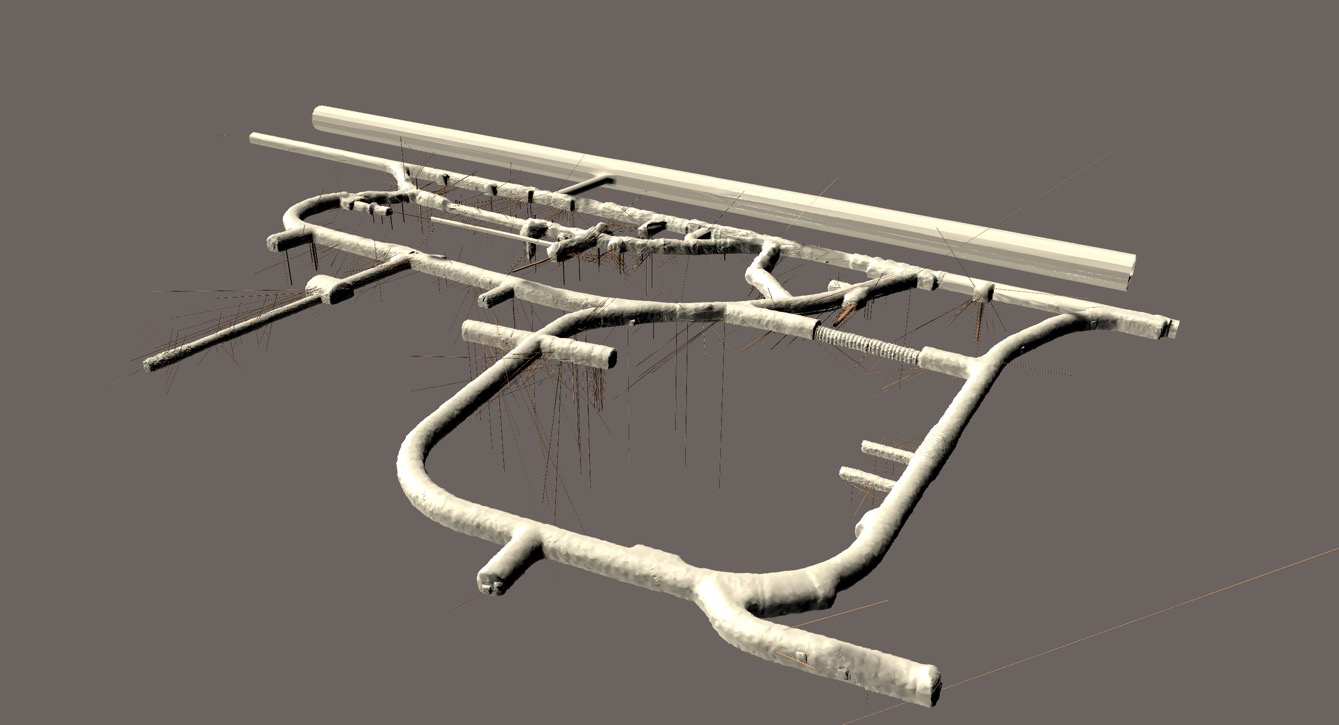
This notebook documents the planned OpenGeoSys representation of the FE mini benchmarks. The original project files and reference results will be added when supplied by the authors. It intentionally does not run an OGS simulation yet.
Reference
Jörg Buchwald et al. (2025): The relevance of two-phase flow in the thermo-hydro-mechanical evolution of clay formations exposed to high temperatures by heat-emitting waste. Applied Thermal Engineering, vol. 264, p. 125379, DOI:10.1016/j.applthermaleng.2024.125379, Publisher link@article{buchwald2025,
abstract = {We compare two-phase flow and Richards flow implementations in OpenGeoSys-6 to model the thermo-hydro-mechanical evolution of heat-emitting waste in clay stone formations. Our quasi-1D example is based on the material sequence and domain properties observed in the FE experiment at the Mt. Terri underground research lab in Switzerland. We examine the validity of the Richards assumption by comparing a thermo-hydro-mechanically (THM) coupled Richards model against two THM-coupled two-phase flow-based models, one where the gas pressure is constrained to atmospheric pressure, and one unconstrained model. The model comparison was conducted with saturation-dependent permeability models at temperatures up to ≈200 °C. Additionally, we consider the impact of two different vapor diffusion models, a gas pressure–independent empirical relationship versus the original De Vries model, which becomes relevant if gas pressure buildup is significant. Our results show excellent agreement between the two models for maximum temperatures around 100∘. Even at higher temperatures, above 150 °C, we observe good agreement, which improves significantly with increasing distance from the heater. Even for the highest heat power where both approaches differ significantly in the high-temperature regions, acceptable agreement can be reached outside those regions, i.e. a couple of tens of centimeters away from the heater, but still in the bentonite barrier domain. This work builds confidence in the use of Richards-based approaches for modeling of the THM processes in nuclear waste repository, and contributes to a knowledge-driven model selection in the context of safety-relevant radioactive waste management.},
author = {Jörg Buchwald and Norbert Grunwald and Wenqing Wang and Hua Shao and Olaf Kolditz and Thomas Nagel},
doi = {https://doi.org/10.1016/j.applthermaleng.2024.125379},
issn = {1359-4311},
journal = {Applied Thermal Engineering},
keywords = {Coupled thermo-hydro-mechanical processes, Non-isothermal two-component two-phase flow, Non-isothermal Richards equation, Nuclear waste disposal, OpenGeoSys},
pages = {125379},
title = {The relevance of two-phase flow in the thermo-hydro-mechanical evolution of clay formations exposed to high temperatures by heat-emitting waste},
url = {https://www.sciencedirect.com/science/article/pii/S1359431124030473},
volume = {264},
year = {2025}
}