URL scale
Field experiment models
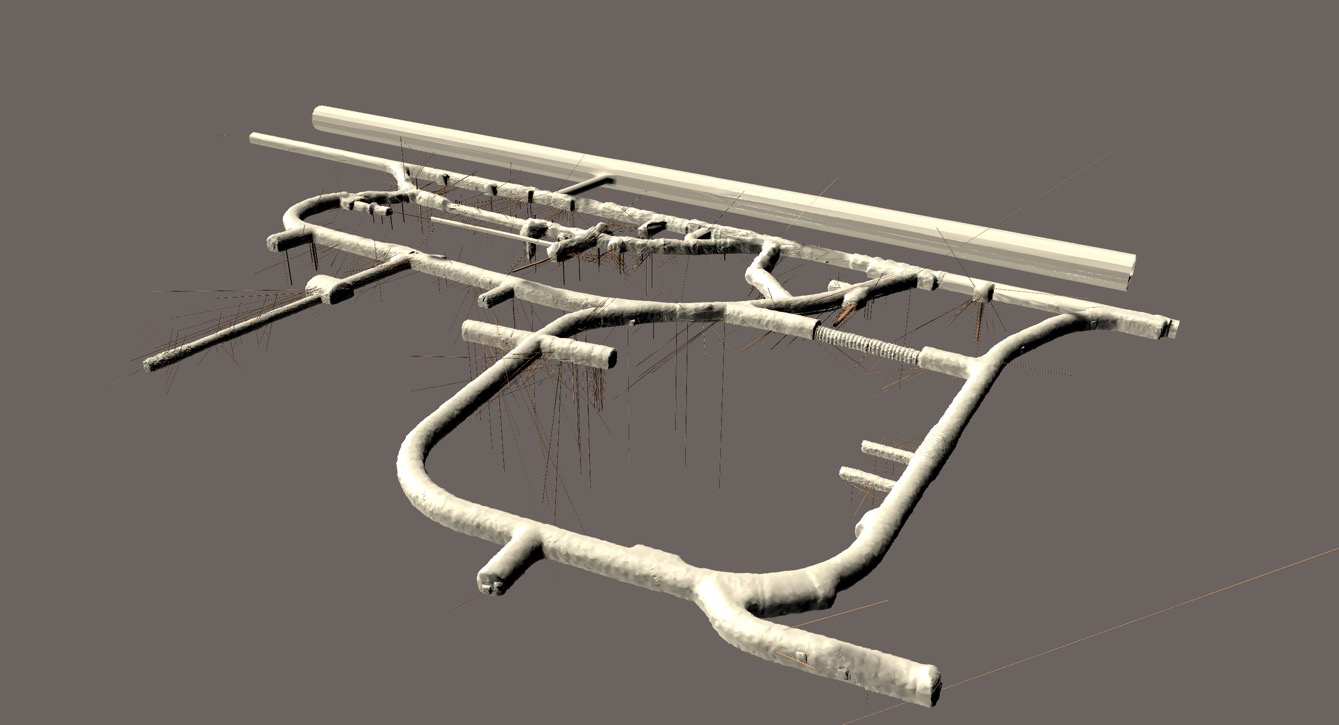
Unlike laboratory experiments (LAB) conducted under well-defined conditions, experimental analysis in underground research laboratories such as Mont Terri (Opalinus clay), Bure (Callovo-Oxfordian clay) and “Reiche Zeche” (gneiss) poses greater modelling challenges due to the uncertain subsurface conditions.
Therefore, modelling in-situ experiments at the URL scale builds an important bridge between the well-defined small laboratory scale and the larger assessment scale. URLs such as Mont Terri (Opalinus clay), Bure (Callovo-Oxfordian clay) and “Reiche Zeche” (gneiss), which are located in various geological settings, provide an important basis for closing the modelling scale gap. In addition to the numerical analysis of in-situ data, URL experiments are also used to define benchmark tests, i.e. the investigation of specific physical processes.
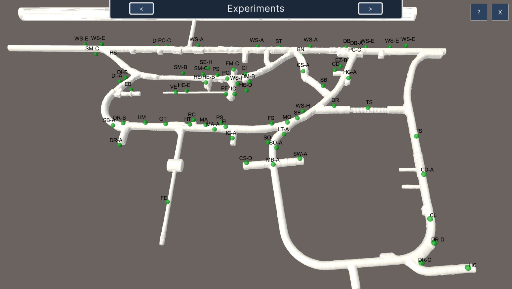
Map of the Mont Terri URL operated by swisstopo, visualised as part of the digital twin (Task VR-A) by Graebling et al. (2022, 2024).
References
-
S. V. Churakov et al.
(2024):
Position paper on high fidelity simulations for coupled processes, multi-physics and chemistry in geological disposal of nuclear waste.
Environmental Earth Sciences,
No. 17,
vol. 83,
p. 521,
DOI:10.1007/s12665-024-11832-7,
Publisher link
@article{Churakov2024, author = {Churakov, S. V. and Claret, F. and Idiart, A. and Jacques, D. and Govaerts, J. and Kolditz, O. and Prasianakis, N. I. and Samper, J.}, doi = {10.1007/s12665-024-11832-7}, journal = {Environmental Earth Sciences}, number = {17}, pages = {521}, title = {Position paper on high fidelity simulations for coupled processes, multi-physics and chemistry in geological disposal of nuclear waste}, url = {https://link.springer.com/article/10.1007/s12665-024-11832-7}, volume = {83}, year = {2024} } -
N Graebling et al.
(2022):
Prototype of a Virtual Experiment Information System for the Mont Terri Underground Research Laboratory.
Front Earth Sci,
vol. 10,
p. art.~946627,
DOI:10.3389/feart.2022.946627
@article{Graebling2022, abstract = {Underground Research Laboratories (URLs) allow geoscientific in-situ experiments at large scale. At the Mont Terri URL in Switzerland, international research groups conduct numerous experiments in parallel. The measured and simulated data as well as research results obtained from them are highly relevant as they improve the general understanding of geological processes, for example in the context of radioactive waste disposal. Unfortunately, the data obtained at the test site is often only available to researchers who are directly involved in a particular experiment. Furthermore, typical visualisation techniques of such data by domain scientists often lack spatial context and accessing and exploring the data requires prior technical knowledge and a high level of effort. We created a digital replica of the Mont Terri URL and thereby implemented a prototype of a Virtual Experiment Information System that integrates highly heterogeneous data from several different sources. It allows accessing and exploring the relevant data embedded in its spatial context without much prior technical knowledge. Both, simulation results and observation data are displayed within the same system. The 4D visualisation approach focuses on three exemplary experiments conducted at Mont Terri and is easily transferable to other experiments or even other URLs. The Unity Game Engine has been used to develop the prototype. This allowed to build the application for various output devices like desktop computers or Virtual Reality hardware without much additional effort. The implemented system reduces the technical effort required to access and explore highly relevant research data and lowers the cognitive effort usually needed to gain insights from measurements, simulation models and context data. Moreover, it promotes exchange among research groups by enabling interactive visualisations embedded in the URL’s spatial context. In addition, a future use of the system for the communication of scientific methods and results to stakeholders or the general public is plausible.}, author = {N Graebling and Ö O Şen and L Bilke and T Cajuhi and D Naumov and W Wang and G Ziefle and D Jaeggi and J Maßmann and G Scheuermann and O Kolditz and K Rink}, doi = {10.3389/feart.2022.946627}, howpublished = {r̆lhttps://www.frontiersin.org/articles/10.3389/feart.2022.946627/full}, journal = {Front Earth Sci}, pages = {art.~946627}, title = {Prototype of a Virtual Experiment Information System for the Mont Terri Underground Research Laboratory}, volume = {10}, year = {2022} } -
N Graebling et al.
(2024):
VR-EX – An Immersive Virtual Reality Serious Game for Science Communication about the ERT Measurements in Mont Terri, Switzerland.
Environ Earth Sci,
vol. 83,
p. art.~318,
DOI:10.1007/s12665-024-11613-2
@article{Graebling2024, abstract = {This paper presents the design, implementation, and evaluation of VR-EX, a combination of a virtual field trip and a serious game in immersive virtual reality. The application’s purpose is the communication of research conducted in the Mont Terri underground research laboratory in Switzerland. VR-EX enables users to actively attend electrical resistivity tomography measurements within a geological experiment, from planning to execution to analysis of the results, and in this way imple- ments an active and playful learning approach. The work conducted in underground research laboratories has a high relevance for society as it contributes to research on the final disposal of nuclear waste. Therefore, the active communication of research methodology and results is crucial to increase understanding of scientific processes and boost interest. VR-EX was evaluated in a user study with 35 participants to measure its overall quality and its effectiveness of the knowledge transfer. Taking the evaluation’s qualitative results into account, the application was improved in an iterative process. Overall, the results prove the good quality of the application and its high effectiveness in terms of knowledge transfer. The reported high engagement, joy, and immersion indicate the benefits of employing immersive virtual reality for vivid science communication.}, author = {N Graebling and G Ziefle and M Furche and R Nicol and S Schefer and M Ziegler and D Jaeggi and C Nussbaum and Y Annanias and S Goldstein and K Rink}, doi = {10.1007/s12665-024-11613-2}, howpublished = {r̆lhttps://link.springer.com/article/10.1007/s12665-024-11613-2}, journal = {Environ Earth Sci}, pages = {art.~318}, title = {VR-EX – An Immersive Virtual Reality Serious Game for Science Communication about the ERT Measurements in Mont Terri, Switzerland}, volume = {83}, year = {2024} } -
Feliks K. Kiszkurno et al.
(2025):
Is more always better? Study on uncertainties introduced by decision-making process of model design — A case study with thermo-osmosis.
International Journal of Rock Mechanics and Mining Sciences,
vol. 189,
p. 106075,
DOI:10.1016/j.ijrmms.2025.106075,
Publisher link
@article{kiszkurno2025, abstract = {Proper understanding and handling of uncertainties is critical for the development of safe and reliable facilities for long-term storage of nuclear waste. To prove their safety, numerical simulations are commonly used. They are based on models including physical processes, constitutive assumptions, material parameters, etc. Numerical simulations only approximate the observed reality. Among sources for this mismatch between observations and simulation results are uncertainties in selecting a correct model of the physical processes taking place in the subsurface and uncertainties in parameter values. The impact they can have on the results of the numerical simulations and conclusions drawn from them can be significant and needs to be explored to improve the trust in demonstrations of safety derived from models and numerical simulations. In this study, this will be done by a joint investigation of uncertainties originating from process model selection and parameter calibration. Existing literature suggests a potentially significant impact of thermo-osmosis (TO) on pore pressure evolution as a result of thermal gradients in clay rocks around nuclear waste canisters. In this study, different process models will be confronted with the common belief that more complex models (with more degrees of freedom) will always yield a better match with data. In this perspective, it could be argued that expanding the physical process with TO can be abused for parameter tweaking, leading to overfitting the observed data independent of physical adequacy. To disprove this, uncertainty quantification and sensitivity analysis methods will be applied to test the impact of multiple combinations of assumptions about physical process, relevance of TO and model parameter values to show that it may not necessarily be the most complex model that will represent the observed data best in a plausible manner.}, author = {Feliks K. Kiszkurno and Jörg Buchwald and Christian B. Silberman and Olaf Kolditz and Thomas Nagel}, doi = {https://doi.org/10.1016/j.ijrmms.2025.106075}, issn = {1365-1609}, journal = {International Journal of Rock Mechanics and Mining Sciences}, keywords = {Numerical modeling, Nuclear waste storage, THM process, Thermo-osmosis}, pages = {106075}, title = {Is more always better? Study on uncertainties introduced by decision-making process of model design — A case study with thermo-osmosis}, url = {https://www.sciencedirect.com/science/article/pii/S1365160925000528}, volume = {189}, year = {2025} } -
Feliks K. Kiszkurno, F. Magri, Thomas Nagel
(2026):
Learning from data – Calibration and improvement of modelling thermo-osmosis effects in THM simulations based on the Mont Terri Deep Borehole experiment.
International Journal of Rock Mechanics and Mining Sciences,
vol. 202,
p. 106513,
DOI:10.1016/j.ijrmms.2026.106513
@article{kiszkurno2026, author = {Feliks K. Kiszkurno and F. Magri and Thomas Nagel}, doi = {10.1016/j.ijrmms.2026.106513}, journal = {International Journal of Rock Mechanics and Mining Sciences}, pages = {106513}, title = {Learning from data – Calibration and improvement of modelling thermo-osmosis effects in THM simulations based on the Mont Terri Deep Borehole experiment}, volume = {202}, year = {2026} } -
Olaf Kolditz et al.
(2025):
SAFENET-2 – fracture evolution in crystalline rocks (from lab to in situ scale).
Safety of Nuclear Waste Disposal,
vol. 3,
p. 15–31,
DOI:10.5194/sand-3-15-2025
@article{Kolditz2025, author = {Kolditz, Olaf and McDermott, Christopher and Yoon, Jeoung Seok and Renner, Jörg and Zhuang, Li and Fraser-Harris, Andrew and Chandler, Michael and Graham, Samuel and Wang, Ju and Mollaali, Mostafa}, doi = {10.5194/sand-3-15-2025}, journal = {Safety of Nuclear Waste Disposal}, pages = {15–31}, title = {SAFENET-2 – fracture evolution in crystalline rocks (from lab to in situ scale)}, url = {https://doi.org/10.5194/sand-3-15-2025}, volume = {3}, year = {2025} } -
N. I. Prasianakis et al.
(2025):
Geochemistry and machine learning: methods and benchmarking.
Environmental Earth Sciences,
No. 5,
vol. 84,
p. 121,
DOI:10.1007/s12665-024-12066-3
@article{Prasianakis2025,
 author = {Prasianakis, N. I. and Laloy, E. and Jacques, D. and Meeussen, J. C. L. and Miron, G. D. and Kulik, D. A. and Idiart, A. and Demirer, E. and Coene, E. and Cochepin, B. and Leconte, M. and Savino, M. E. and Samper-Pilar, J. and De Lucia, M. and Churakov, S. V. and Kolditz, O. and Yang, C. and Samper, J. and Claret, F.},
 doi = {10.1007/s12665-024-12066-3},
 journal = {Environmental Earth Sciences},
 number = {5},
 pages = {121},
 title = {Geochemistry and machine learning: methods and benchmarking},
 url = {https://doi.org/10.1007/s12665-024-12066-3},
 volume = {84},
 year = {2025}
}