Double diffusion experiment in Boom Clay
 This page is based on a Jupyter notebook.




Note: Placeholder benchmark
This notebook documents the planned OpenGeoSys representation of the double through-diffusion experiment. The original project files and reference results will be added when supplied by the authors. It intentionally does not run an OGS simulation yet.
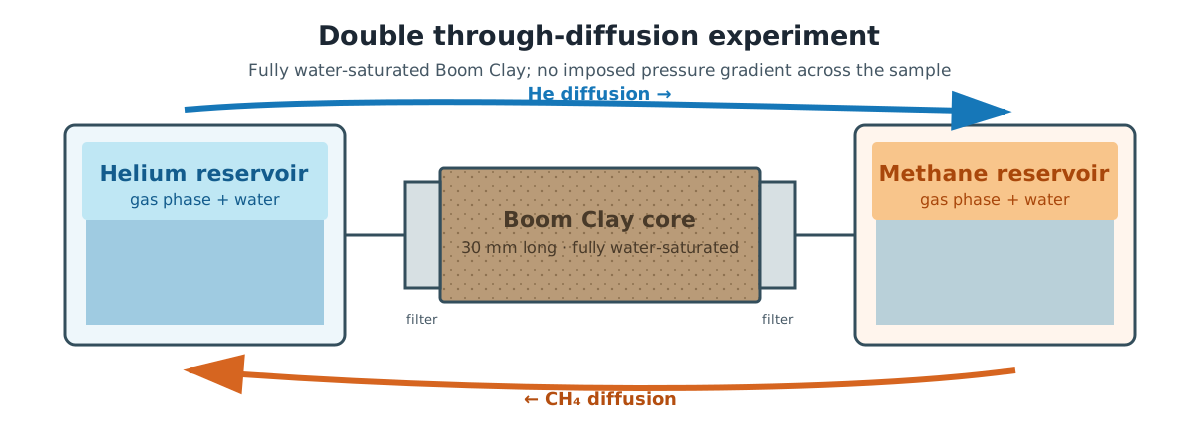
Two gas species diffuse in opposite directions through a fully water-saturated Boom Clay sample. Helium is initially supplied from the left reservoir and methane from the right reservoir. The experiment was performed at SCK CEN and reported by Pitz et al. (2024).
Project context
The benchmark was developed within the European Joint Programme on Radioactive Waste Management (EURAD), Work Package GAS (EURAD WP-GAS). The project was funded by the Horizon 2020 Euratom programme under grant agreement No. 847593 (2019–2024).
Experiment at a glance
| Item | Description |
|---|---|
| Host material | Fully water-saturated Boom Clay |
| Specimen | Cylinder, length 30 mm, radius 40 mm |
| Reservoirs | Two 1 L vessels with water and a gas phase |
| Initial gases | Helium (left) and methane (right), initially 1 MPa total pressure |
| Transport | Dissolution in pore water and molecular diffusion; no imposed pressure-driven advection |
| Observations | Time-dependent reservoir pressure and gas composition, measured by gas chromatography over 72 days |
Under the experiment’s conditions, each gas moves down its own concentration gradient: helium towards the methane vessel and methane towards the helium vessel. Gas–water partitioning is assumed to be at instantaneous equilibrium and is described by Henry’s law. The downstream gas concentration is obtained from the accumulated component mass leaving the clay sample, together with the water and gas volumes of that reservoir.
Reference
Michael Pitz et al. (2024): On Multi-Component Gas Migration in Single-Phase Systems. Rock Mechanics and Rock Engineering, No. 6, vol. 57, p. 4251-4264, DOI:10.1007/s00603-024-03838-1@article{Pitz2024,
abstract = {The present work deals with diffusion of gases in fully saturated porous media. We test and validate the gas transport mechanism of dissolution and diffusion, implemented in the TH2M process class in the open-source finite-element software OpenGeoSys. We discuss the importance of gas diffusion for the integrity of the multi-barrier system. Furthermore, we present a multi-component mass balance equation implementation in Python, which serves as a reference for the two-component TH2M implementation and allows for a discussion of multi-component gas diffusion in liquids. We verify and validate the numerical implementations as follows: First, we come up with a set of numerical benchmarks in which solutions obtained by the two-component TH2M and multi-component implementations are compared. Thus, we show under which conditions predictions made by the TH2M model can be used for multi-component gas systems. Finally, the work is validated using a through diffusion experiment performed at Belgium's Nuclear Research Centre SCK CEN and a sensitivity analysis is conducted based on the featured experiment. The results of this work illustrate that predictions by both the two- and four-component models match the laboratory findings very well. Therefore, we conclude that also the two-component implementation can reflect the multi-component processes well under the given constraints such as full saturation.},
author = {Pitz, Michael and Jacops, Elke and Grunwald, Norbert and Ziefle, Gesa and Nagel, Thomas},
day = {01},
doi = {10.1007/s00603-024-03838-1},
issn = {1434-453X},
journal = {Rock Mechanics and Rock Engineering},
month = {Jun},
number = {6},
pages = {4251-4264},
title = {On Multi-Component Gas Migration in Single-Phase Systems},
url = {https://doi.org/10.1007/s00603-024-03838-1},
volume = {57},
year = {2024}
}