DFN generating using Porepy
 This page is based on a Jupyter notebook.



import json…
(click to toggle)
import json
import os
from pathlib import Path

import numpy as np
import porepy as pp
import pyvista as pv
from numpy.random import default_rng/home/gitlab-runner/.cache/uv/archive-v0/wqq-4kET4SZuuvIYhi8Co/lib/python3.14/site-packages/porepy/utils/ui_and_logging.py:45: TqdmExperimentalWarning: Using `tqdm.autonotebook.tqdm` in notebook mode. Use `tqdm.tqdm` instead to force console mode (e.g. in jupyter console)
from tqdm.autonotebook import tqdm as progressbar_class # type: ignore
out_dir = Path(os.environ.get("OGS_TESTRUNNER_OUT_DIR", "_out"))
if not out_dir.exists():
    out_dir.mkdir(parents=True)
orig_dir = Path.cwd()DFN generating using Porepy
Note: This script generates the mesh for DFNbyPorePy_to_OGS.py
PorePy is an open-source Python library developed by the University of Bergen, designed for simulating multiphysics processes in fractured and porous media. It emphasizes discrete fracture network (DFN) modeling through a mixed-dimensional approach.
- Official site: PorePy at University of Bergen
- Source code: PorePy GitHub Repository
Installation
Install PorePy within the same virtual environment as OGS:
pip install porepyFor full installation instructions, see the PorePy Installation Guide.
Input data
domain_size = 100.0…
(click to toggle)
domain_size = 100.0
mesh_size_boundary = 0.1 * domain_size
mesh_size_fracture = 0.05 * domain_size
mesh_size_min = 0.01 * domain_sizeDomain seteup
Defines the minimum and maximum coordinates of a 3D cubic domain.
mins = np.array([0.0, 0.0, 0.0])…
(click to toggle)
mins = np.array([0.0, 0.0, 0.0])
maxs = np.array([domain_size, domain_size, domain_size])
bounding_box = {
    "xmin": mins[0],
    "xmax": maxs[0],
    "ymin": mins[1],
    "ymax": maxs[1],
    "zmin": mins[2],
    "zmax": maxs[2],
}
domain = pp.Domain(bounding_box=bounding_box)Fracture generation loop
- The loop iterates
n_fracturestimes, with each iteration generating a single fracture. - For every fracture:
- A
random centeris generated within the domain by scaling a uniformly distributed random vector. - A
random radiusis selected within theradius_\text{R}ange, setting its size between the allowed minimum and maximum values. - Both the
major axisandminor axisare set equal to the radius—while PorePy supports ellipses, we’re using circular fractures here. Strike and dip anglesare randomly drawn from the interval $[-\frac{\pi}{2}, \frac{\pi}{2}]$.- These angles define the fracture plane’s orientation (see link):
- Strike angle: Sets the direction of the rotation axis in the horizontal plane, measured from the x-axis.
- Dip angle: Describes the tilt of the fracture plane from the horizontal.
- These angles define the fracture plane’s orientation (see link):
- A
use_saved_fractures = True…
(click to toggle)
use_saved_fractures = True
fracture_params_file = Path("fracture_params.json")
radius_range = np.array([50, 80])
n_fractures = 10

# borehole
borehole_height = 60
borehole_radius = maxs[0] * 0.005  # radius in x/y
z_center = maxs[2]
y_center = 0.5 * (mins[1] + maxs[1])
x_left = 0.2 * maxs[0]
x_right = 0.8 * maxs[0]
fractures = []…
(click to toggle)
fractures = []
if use_saved_fractures and fracture_params_file.exists():
    fracture_params = json.loads(fracture_params_file.read_text())
    print("Loaded existing fracture parameters.")
else:
    rng = default_rng(12345)
    fracture_params = []
    for _ in range(n_fractures):
        center = rng.random(3) * (maxs - mins) + mins

        radius = rng.random() * (radius_range[1] - radius_range[0]) + radius_range[0]
        major_axis = minor_axis = radius

        major_axis_angle = rng.uniform(0, 2 * np.pi)
        strike_angle = rng.uniform(-0.5 * np.pi, 0.5 * np.pi)
        dip_angle = rng.uniform(-0.5 * np.pi, 0.5 * np.pi)

        fracture_params.append(
            {
                "center": center.tolist(),
                "major_axis": major_axis,
                "minor_axis": minor_axis,
                "major_axis_angle": major_axis_angle,
                "strike_angle": strike_angle,
                "dip_angle": dip_angle,
            }
        )

    fracture_params_file.write_text(json.dumps(fracture_params, indent=4))
    print("New fracture parameters generated and saved explicitly.")

for p in fracture_params:
    frac = pp.create_elliptic_fracture(
        center=np.array(p["center"]),
        major_axis=p["major_axis"],
        minor_axis=p["minor_axis"],
        major_axis_angle=p["major_axis_angle"],
        strike_angle=p["strike_angle"],
        dip_angle=p["dip_angle"],
    )
    fractures.append(frac)


#  vertical boreholes as long, thin fractures
center_left = np.array([x_left, y_center, z_center])
borehole_left = pp.create_elliptic_fracture(
    center=center_left,
    major_axis=borehole_height,
    minor_axis=borehole_radius,
    major_axis_angle=np.pi / 2,
    strike_angle=0.0,
    dip_angle=-0.5 * np.pi,
)
fractures.append(borehole_left)

center_right = np.array([x_right, y_center, z_center])
borehole_right = pp.create_elliptic_fracture(
    center=center_right,
    major_axis=borehole_height,
    minor_axis=borehole_radius,
    major_axis_angle=np.pi / 2,
    strike_angle=0.0,
    dip_angle=-0.5 * np.pi,
)
fractures.append(borehole_right)Loaded existing fracture parameters.
Fracture network generation
Once all fractures are generated, they’re passed as a list to create_fracture_network(), along with the domain’s bounding box. This creates a 3D Fracture Network object, representing the full 3D fracture system. The object takes care of intersection detection, applies the orientation from strike/dip angles, and prepares the geometry for meshing and simulation (see FractureNetwork3d documentation).
The system consists of two vertical fractures representing inlet and outlet boreholes, modeled as long, thin elliptic fractures. The minor axis is set to a small value (borehole_Radius = maxs[0] * 0.005) to reflect the narrow borehole dimensions.
- Left Borehole: Located at
[x_Left, y_Center, zmax], with a major axis ofborehole_heightand a minor axis ofborehole_Radius, oriented vertically (major_axis_angle =$\frac{\pi}{2}$,dip_angle =$\frac{\pi}{2}$). - Right Borehole: Located at
[x_Right, y_Center, zmax], with identical dimensions and orientation as the left borehole.
Both fractures are added to the fractures list.
network = pp.create_fracture_network(fractures=fractures, domain=domain)Meshing the fracture network
We generate the computational mesh using PorePy’s mixed-dimensional approach:
cell_size_boundary: maximum cell size near the domain boundaries.cell_size_fracture: target cell size along the fracture surfaces.cell_size_min: minimum allowed cell size anywhere in the mesh.simplex: enables triangular (2D) or tetrahedral (3D) elements.
This produces a mixed-dimensional grid (mdg) with 3D rock matrix cells, 2D fracture surfaces, and lower-dimensional intersections.
For fracture-only simulations, the 3D matrix is removed, leaving just the 2D fractures and their intersections.
mesh_args = {…
(click to toggle)
mesh_args = {
    "cell_size_boundary": mesh_size_boundary,
    "cell_size_fracture": mesh_size_fracture,
    "cell_size_min": mesh_size_min,
    "export": True,
    "filename": "mdg2d",
}

os.chdir(out_dir)
mdg = pp.create_mdg("simplex", mesh_args, network)
os.chdir(orig_dir)

mdg2d = mdg.copy()
for sd in list(mdg2d.subdomains()):
    if sd.dim == 3:
        mdg2d.remove_subdomain(sd)

for g in list(mdg2d.subdomains(dim=1)):
    cn = g.cell_nodes()
    if g.num_cells == 0 or cn.indices.size == 0 or cn.indptr.size <= 1:
mdg2d.remove_subdomain(g)Export the mesh to VTU format
Creates a VTK file of the 2D mixed-dimensional grid (mdg2d) using Exporter (see link). The output is compatible with visualization tools like ParaView, and serves as input for OpenGeoSys.
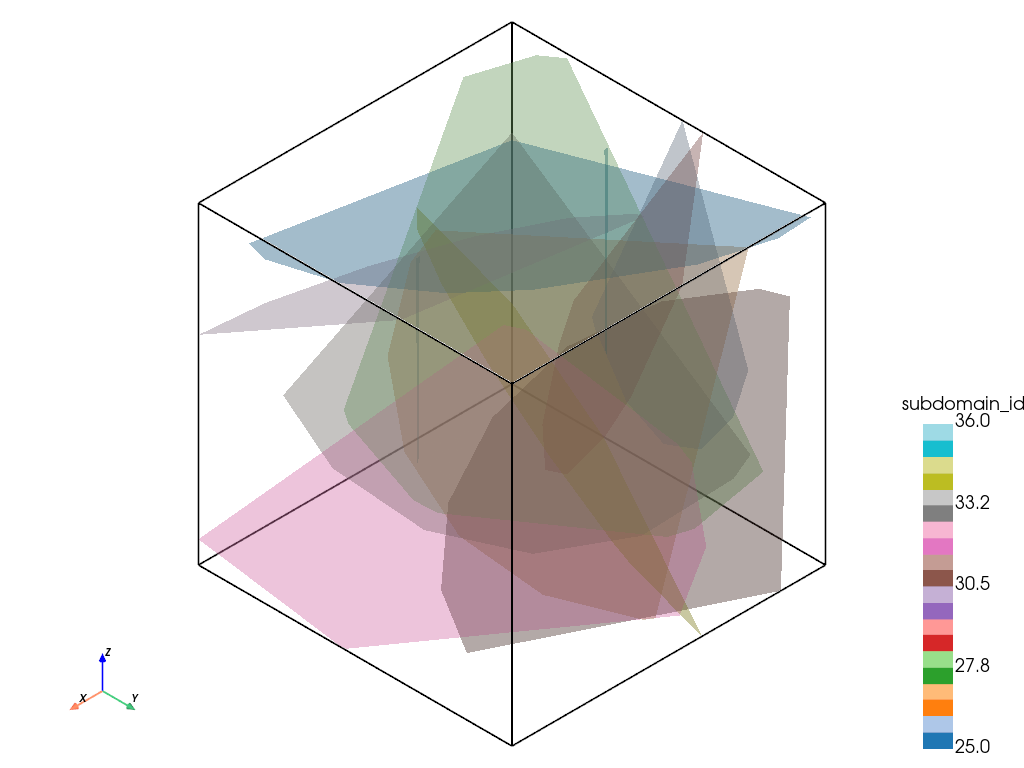
exporter = pp.Exporter(mdg2d, "mixed_dimensional_grid", folder_name=out_dir).write_vtu()
os.chdir(orig_dir)…
(click to toggle)
os.chdir(orig_dir)
try:
    pv.set_jupyter_backend("static")
except Exception as e:
    print("PyVista backend not set:", e)

plot_mesh = pv.read(out_dir / "mixed_dimensional_grid_2.vtu")
scalar_name = "MaterialIDs" if "MaterialIDs" in plot_mesh.cell_data else "subdomain_id"

plotter = pv.Plotter(off_screen=True)
plotter.add_mesh(
    plot_mesh,
    scalars=scalar_name,
    cmap="tab20",
    opacity=0.4,
    scalar_bar_args={"title": scalar_name, "vertical": True},
)
plotter.add_mesh(plot_mesh.outline(), color="black", line_width=2)
plotter.show_axes()
plotter.enable_parallel_projection()
plotter.view_isometric()

output_path = out_dir / "mesh_overview.png"
plotter.screenshot(str(output_path))
plotter.show()
plotter.close()[0m[33m2026-05-18 15:53:33.675 ( 12.720s) [ 7F3EC782A400]vtkXOpenGLRenderWindow.:1460 WARN| bad X server connection. DISPLAY=[0m
Mesh-based regression checks
The following assertions validate fracture geometry using mesh-derived quantities (orientation and in-plane metrics), not node-to-node equality.
With PorePy v1.12, different operating systems can generate meshes with different numbers of nodes/cells for the same DFN input (e.g., Linux vs macOS). Using geometry-invariant checks keeps the validation robust across platforms.
def _expected_normal(strike_angle, dip_angle):…
(click to toggle)
def _expected_normal(strike_angle, dip_angle):
    return np.array(
        [
            -np.sin(strike_angle) * np.sin(dip_angle),
            np.cos(strike_angle) * np.sin(dip_angle),
            -np.cos(dip_angle),
        ]
    )


def _angle_diff_mod_pi(a, b):
    """Smallest absolute difference of two line orientations (period pi)."""
    return np.abs((a - b + 0.5 * np.pi) % np.pi - 0.5 * np.pi)


mesh_candidates = [
    out_dir / "mixed_dimensional_grid_2.vtu",
    out_dir / "mixed_dimensional_grid.vtu",
]
mesh_path = next((p for p in mesh_candidates if p.exists()), None)
assert mesh_path is not None, "Exported mesh file not found for fracture checks."

mesh = pv.read(mesh_path)
if "MaterialIDs" in mesh.cell_data:
    material_ids = np.asarray(mesh.cell_data["MaterialIDs"], dtype=int)
elif "subdomain_id" in mesh.cell_data:
    subdomain_id = np.asarray(mesh.cell_data["subdomain_id"], dtype=int)
    material_ids = subdomain_id - subdomain_id.min()
else:
    msg = "Neither 'MaterialIDs' nor 'subdomain_id' found in exported mesh."
    raise KeyError(msg)

fracture_params_from_json = json.loads(fracture_params_file.read_text())

normal_alignment_tol = 1e-8
strike_err_tol_deg = 1e-3
dip_abs_err_tol_deg = 1e-3
plane_dist_tol = 1e-8
center_plane_dist_tol = 1e-5
radius_upper_tol = 1e-8
radius_touch_tol = 1e-6

detail_rows = []
for mat_id, p in enumerate(fracture_params_from_json):
    cell_idx = np.flatnonzero(material_ids == mat_id)
    assert cell_idx.size > 0, f"No mesh cells found for fracture MaterialID {mat_id}."

    frac_mesh = (
        mesh.extract_cells(cell_idx)
        .extract_surface(algorithm=None)
        .triangulate()
        .compute_normals(
            cell_normals=True,
            point_normals=False,
            consistent_normals=False,
            auto_orient_normals=False,
            inplace=False,
        )
        .compute_cell_sizes(area=True)
    )

    cell_normals = np.asarray(frac_mesh.cell_data["Normals"], dtype=float)
    cell_areas = np.asarray(frac_mesh.cell_data["Area"], dtype=float)

    normal_expected = _expected_normal(
        float(p["strike_angle"]),
        float(p["dip_angle"]),
    )
    dots = cell_normals @ normal_expected

    # Normal direction on triangles can flip; align signs before averaging.
    cell_normals[dots < 0.0] *= -1.0
    normal_avg = (cell_normals * cell_areas[:, None]).sum(axis=0)
    normal_avg /= np.linalg.norm(normal_avg)

    alignment = np.abs(
        np.dot(normal_avg, normal_expected)
        / (np.linalg.norm(normal_avg) * np.linalg.norm(normal_expected))
    )

    angle_err_deg = float(np.degrees(np.arccos(np.clip(alignment, -1.0, 1.0))))

    strike_ref = np.mod(float(p["strike_angle"]), np.pi)
    strike_mesh = np.mod(np.arctan2(-normal_avg[0], normal_avg[1]), np.pi)
    strike_err_deg = float(np.degrees(_angle_diff_mod_pi(strike_mesh, strike_ref)))

    dip_ref_abs_deg = float(np.degrees(np.abs(float(p["dip_angle"]))))
    dip_mesh_abs_deg = float(np.degrees(np.arccos(np.clip(-normal_avg[2], -1.0, 1.0))))
    dip_abs_err_deg = abs(dip_mesh_abs_deg - dip_ref_abs_deg)

    pts = np.asarray(frac_mesh.points, dtype=float)
    center_ref = np.asarray(p["center"], dtype=float)
    signed_plane_dist = (pts - center_ref) @ normal_expected
    max_plane_dist = float(np.max(np.abs(signed_plane_dist)))
    center_to_plane_dist = float(np.abs((center_ref - pts[0]) @ normal_avg))

    # Radius checks are done in-plane around the JSON centre.
    vec = pts - center_ref
    vec_plane = vec - np.outer(vec @ normal_expected, normal_expected)
    radius_max = float(np.linalg.norm(vec_plane, axis=1).max())
    axis_major = float(p["major_axis"])
    axis_minor = float(p["minor_axis"])

    assert alignment > 1.0 - normal_alignment_tol, (
        f"Fracture {mat_id}: |dot(n_mesh, n_json)|={alignment:.12f} "
        f"is below {1.0 - normal_alignment_tol:.12f}."
    )
    assert strike_err_deg < strike_err_tol_deg, (
        f"Fracture {mat_id}: strike mismatch {strike_err_deg:.3e} deg "
        f"(tol {strike_err_tol_deg:.3e} deg)."
    )
    assert dip_abs_err_deg < dip_abs_err_tol_deg, (
        f"Fracture {mat_id}: |dip| mismatch {dip_abs_err_deg:.3e} deg "
        f"(tol {dip_abs_err_tol_deg:.3e} deg)."
    )
    assert max_plane_dist < plane_dist_tol, (
        f"Fracture {mat_id}: points are off JSON plane by {max_plane_dist:.3e} m "
        f"(tol {plane_dist_tol:.3e} m)."
    )
    assert center_to_plane_dist < center_plane_dist_tol, (
        f"Fracture {mat_id}: JSON centre is off mesh plane by "
        f"{center_to_plane_dist:.3e} m (tol {center_plane_dist_tol:.3e} m)."
    )
    assert radius_max <= axis_major + radius_upper_tol, (
        f"Fracture {mat_id}: mesh radius {radius_max:.6e} exceeds JSON major axis "
        f"{axis_major:.6e} (tol {radius_upper_tol:.1e})."
    )
    if np.isclose(axis_major, axis_minor, rtol=0.0, atol=1e-12):
        assert abs(radius_max - axis_major) < radius_touch_tol, (
            f"Fracture {mat_id}: circular fracture radius from mesh ({radius_max:.6e}) "
            f"does not match JSON radius ({axis_major:.6e}) within {radius_touch_tol:.1e}."
        )

    detail_rows.append(
        {
            "strike_err_deg": strike_err_deg,
            "dip_err_deg": dip_abs_err_deg,
            "axis_err_m": abs(radius_max - axis_major),
            "normal_err_deg": angle_err_deg,
            "max_plane_dist_m": max_plane_dist,
            "center_plane_dist_m": center_to_plane_dist,
        }
    )

max_strike_err = max(r["strike_err_deg"] for r in detail_rows)
max_dip_err = max(r["dip_err_deg"] for r in detail_rows)
max_axis_err = max(r["axis_err_m"] for r in detail_rows)
max_normal_err = max(r["normal_err_deg"] for r in detail_rows)
max_plane_dist = max(r["max_plane_dist_m"] for r in detail_rows)
max_center_dist = max(r["center_plane_dist_m"] for r in detail_rows)
print(
    f"Fracture validation passed ({len(detail_rows)}/{len(fracture_params_from_json)}). "
    f"Max errors: strike={max_strike_err:.3e} deg, dip={max_dip_err:.3e} deg, "
    f"axis={max_axis_err:.3e} m, normal={max_normal_err:.3e} deg, "
    f"plane={max_plane_dist:.3e} m, centre={max_center_dist:.3e} m."
)Fracture validation passed (10/10). Max errors: strike=1.588e-06 deg, dip=1.604e-06 deg, axis=1.421e-14 m, normal=1.708e-06 deg, plane=9.826e-12 m, centre=1.743e-06 m.
This article was written by Mostafa Mollaali, Thomas Nagel. If you are missing something or you find an error please let us know.
Generated with Hugo 0.150.1
in CI job 743172
|
Last revision: April 28, 2025