Thermoelastic Stress
Problem description
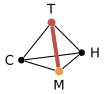
We solve a thermo-mechanical homogeneous model in cube domain. The dimensions of this cube model are 1 m in all directions. The boundary conditions and temperature loadings, as well as the material can refer Chapter 14 in Kolditz et al. for detailed problem description:
O. Kolditz et al. (2012): OpenGeoSys: an open-source initiative for numerical simulation of thermo-hydro-mechanical/chemical (THM/C) processes in porous media. Environmental Earth Sciences, No. 2, vol. 67, p. 589-599, DOI:10.1007/s12665-012-1546-x@article{Kolditz2012,
abstract = {In this paper we describe the OpenGeoSys (OGS) project, which is a scientific open-source initiative for numerical simulation of thermo-hydro-mechanical-chemical processes in porous media. The basic concept is to provide a flexible numerical framework (using primarily the Finite Element Method (FEM)) for solving multifield problems in porous and fractured media for applications in geoscience and hydrology. To this purpose OGS is based on an object-oriented FEM concept including a broad spectrum of interfaces for pre- and postprocessing. The OGS idea has been in development since the mid-eighties. We provide a short historical note about the continuous process of concept and software development having evolved through Fortran, C, and C++ implementations. The idea behind OGS is to provide an open platform to the community, outfitted with professional software-engineering tools such as platform-independent compiling and automated benchmarking. A comprehensive benchmarking book has been prepared for publication. Benchmarking has been proven to be a valuable tool for cooperation between different developer teams, for example, for code comparison and validation purposes (DEVOVALEX and CO2 BENCH projects). On one hand, object-orientation (OO) provides a suitable framework for distributed code development; however, the parallelization of OO codes still lacks efficiency. High-performance-computing efficiency of OO codes is subject to future research.},
author = {Kolditz, O. and Bauer, S. and Bilke, L. and Böttcher, N. and Delfs, J. O. and Fischer, T. and Görke, U. J. and Kalbacher, T. and Kosakowski, G. and McDermott, C. I. and Park, C. H. and Radu, F. and Rink, K. and Shao, H. and Shao, H. B. and Sun, F. and Sun, Y. Y. and Singh, A. K. and Taron, J. and Walther, M. and Wang, W. and Watanabe, N. and Wu, Y. and Xie, M. and Xu, W. and Zehner, B.},
category = {Methods},
day = {01},
doi = {10.1007/s12665-012-1546-x},
issn = {1866-6299},
journal = {Environmental Earth Sciences},
month = {Sep},
number = {2},
pages = {589-599},
title = {OpenGeoSys: an open-source initiative for numerical simulation of thermo-hydro-mechanical/chemical (THM/C) processes in porous media},
volume = {67},
year = {2012}
}
Results and evaluation
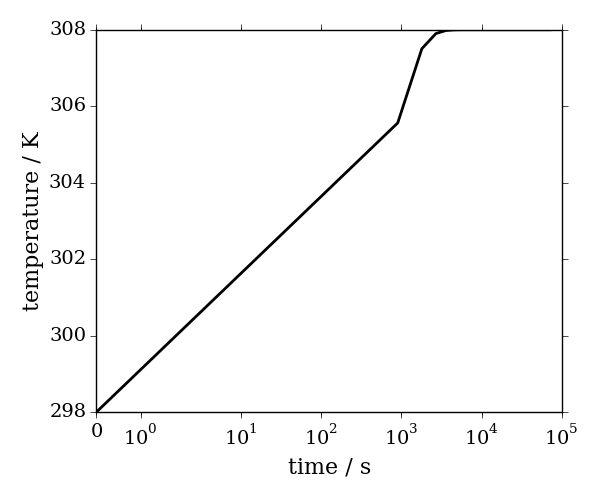
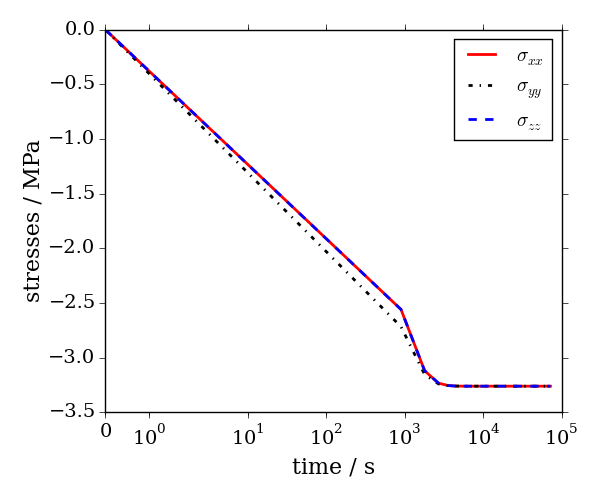
Result showing temperature and stresses development with time in the centre node of the model:
The analytical solution of stresses after heating is:
$$\begin{equation} \sigma_{xx} = \sigma_{yy} = \sigma_{zz} = - \frac{\alpha \Delta T E}{1 - 2 \nu} = - 3.260869\, \textrm{MPa} \end{equation}$$The relative error between the numerical simulation and the analytical solution is 9.2⋅10-13.
References
O. Kolditz et al. (2012): OpenGeoSys: an open-source initiative for numerical simulation of thermo-hydro-mechanical/chemical (THM/C) processes in porous media. Environmental Earth Sciences, No. 2, vol. 67, p. 589-599, DOI:10.1007/s12665-012-1546-x@article{Kolditz2012,
abstract = {In this paper we describe the OpenGeoSys (OGS) project, which is a scientific open-source initiative for numerical simulation of thermo-hydro-mechanical-chemical processes in porous media. The basic concept is to provide a flexible numerical framework (using primarily the Finite Element Method (FEM)) for solving multifield problems in porous and fractured media for applications in geoscience and hydrology. To this purpose OGS is based on an object-oriented FEM concept including a broad spectrum of interfaces for pre- and postprocessing. The OGS idea has been in development since the mid-eighties. We provide a short historical note about the continuous process of concept and software development having evolved through Fortran, C, and C++ implementations. The idea behind OGS is to provide an open platform to the community, outfitted with professional software-engineering tools such as platform-independent compiling and automated benchmarking. A comprehensive benchmarking book has been prepared for publication. Benchmarking has been proven to be a valuable tool for cooperation between different developer teams, for example, for code comparison and validation purposes (DEVOVALEX and CO2 BENCH projects). On one hand, object-orientation (OO) provides a suitable framework for distributed code development; however, the parallelization of OO codes still lacks efficiency. High-performance-computing efficiency of OO codes is subject to future research.},
author = {Kolditz, O. and Bauer, S. and Bilke, L. and Böttcher, N. and Delfs, J. O. and Fischer, T. and Görke, U. J. and Kalbacher, T. and Kosakowski, G. and McDermott, C. I. and Park, C. H. and Radu, F. and Rink, K. and Shao, H. and Shao, H. B. and Sun, F. and Sun, Y. Y. and Singh, A. K. and Taron, J. and Walther, M. and Wang, W. and Watanabe, N. and Wu, Y. and Xie, M. and Xu, W. and Zehner, B.},
category = {Methods},
day = {01},
doi = {10.1007/s12665-012-1546-x},
issn = {1866-6299},
journal = {Environmental Earth Sciences},
month = {Sep},
number = {2},
pages = {589-599},
title = {OpenGeoSys: an open-source initiative for numerical simulation of thermo-hydro-mechanical/chemical (THM/C) processes in porous media},
volume = {67},
year = {2012}
}
This article was written by Xing-Yuan Miao. If you are missing something or you find an error please let us know.
Generated with Hugo 0.150.1
in CI job 743172
|
Last revision: February 5, 2026
Commit: [py,cmake] Allow Python 3.14. 4d949dd99c
| Edit this page on