Back to Model Hub
MODEL COLLECTION
Development of Coupled models and their VaLidation against Experiments
Validation models against experimental data
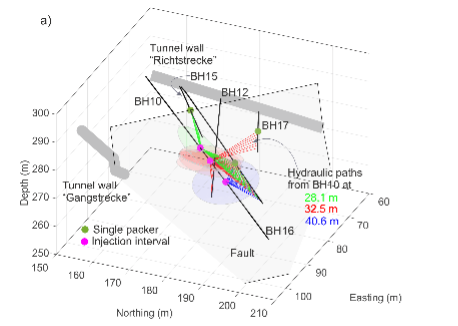
Source: Jörg Renner (Ruhr University Bochum)
The DECOVALEX project is an international research collaboration and model comparison initiative, established in 1992, aimed at advancing the understanding and modelling of coupled thermo-hydro-mechanical-chemical (THMC) processes in geological systems. The current project (2024-2027) is now in its ninth phase and we want to introduce a new framework for online benchmarking and model comparison. The first examples have been implemented in the SAFENET and ANALOG tasks.
References
-
Jung-Wook Park et al.
(2025):
A novel FEM–DEM coupling methodology for hydro-mechanical modeling in fractured geological media.
International Journal of Rock Mechanics and Mining Sciences,
vol. 196,
p. 106324,
DOI:10.1016/j.ijrmms.2025.106324
@article{Park2025, author = {Park, Jung-Wook and Park, Chan-Hee and Park, Eui-Seob and Kolditz, Olaf}, doi = {10.1016/j.ijrmms.2025.106324}, journal = {International Journal of Rock Mechanics and Mining Sciences}, pages = {106324}, title = {A novel FEM–DEM coupling methodology for hydro-mechanical modeling in fractured geological media}, url = {https://doi.org/10.1016/j.ijrmms.2025.106324}, volume = {196}, year = {2025} } -
Sonja Kaiser et al.
(2025):
Differential assessment of effects of increasing model complexity in THM coupled models of the FE experiment at Mt. Terri.
Geomechanics for Energy and the Environment,
vol. 42,
p. 100637,
DOI:10.1016/j.gete.2025.100637,
Publisher link
@article{Kaiser2025, author = {Kaiser, Sonja and Wang, Wenqing and Buchwald, Jörg and Naumov, Dmitri and Chaudhry, A. A. and Nagel, Thomas}, doi = {10.1016/j.gete.2025.100637}, journal = {Geomechanics for Energy and the Environment}, pages = {100637}, title = {Differential assessment of effects of increasing model complexity in THM coupled models of the FE experiment at Mt. Terri}, url = {https://www.sciencedirect.com/science/article/pii/S2352380825000024}, volume = {42}, year = {2025} } -
Olaf Kolditz et al.
(2025):
SAFENET-2 – fracture evolution in crystalline rocks (from lab to in situ scale).
Safety of Nuclear Waste Disposal,
vol. 3,
p. 15–31,
DOI:10.5194/sand-3-15-2025
@article{Kolditz2025, author = {Kolditz, Olaf and McDermott, Christopher and Yoon, Jeoung Seok and Renner, Jörg and Zhuang, Li and Fraser-Harris, Andrew and Chandler, Michael and Graham, Samuel and Wang, Ju and Mollaali, Mostafa}, doi = {10.5194/sand-3-15-2025}, journal = {Safety of Nuclear Waste Disposal}, pages = {15–31}, title = {SAFENET-2 – fracture evolution in crystalline rocks (from lab to in situ scale)}, url = {https://doi.org/10.5194/sand-3-15-2025}, volume = {3}, year = {2025} } -
Eike Radeisen et al.
(2024):
Combination of a failure index and a dilatancy-dependent permeability model in hydro-mechanically-coupled numerical simulations of argillaceous rock formations of the Callovo-Oxfordian (COx).
Rock Mechanics and Rock Engineering,
No. 6,
vol. 57,
p. 4285–4298,
DOI:10.1007/s00603-024-03763-3
@article{Radeisen2024, author = {Radeisen, Eike and Shao, Hua and Pitz, Michael and Hesser, Jürgen and Kolditz, Olaf and Wang, Wenqing}, doi = {10.1007/s00603-024-03763-3}, journal = {Rock Mechanics and Rock Engineering}, number = {6}, pages = {4285–4298}, title = {Combination of a failure index and a dilatancy-dependent permeability model in hydro-mechanically-coupled numerical simulations of argillaceous rock formations of the Callovo-Oxfordian (COx)}, url = {https://doi.org/10.1007/s00603-024-03763-3}, volume = {57}, year = {2024} } -
Mostafa Mollaali et al.
(2023):
Comparative verification of hydro-mechanical fracture behavior: Task G of international research project DECOVALEX–2023.
International Journal of Rock Mechanics and Mining Sciences,
vol. 170,
p. 105530,
DOI:10.1016/j.ijrmms.2023.105530
@article{Mollaali2023,
 author = {Mollaali, Mostafa and Kolditz, Olaf and Hu, Mengsu and Park, Chan–Hee and Park, Jung–Wook and McDermott, Christopher Ian and Chittenden, Neil and Bond, Alexander and Yoon, Jeoung Seok and Zhou, Jian and Pan, Peng–Zhi and Liu, Hejuan and Hou, Wenbo and Lei, Hongwu and Zhang, Liwei and Nagel, Thomas and Barsch, Markus and Wang, Wenqing and Nguyen, Son and Kwon, Saeha and Lee, Changsoo and Yoshioka, Keita},
 doi = {10.1016/j.ijrmms.2023.105530},
 journal = {International Journal of Rock Mechanics and Mining Sciences},
 pages = {105530},
 title = {Comparative verification of hydro-mechanical fracture behavior: Task G of international research project DECOVALEX–2023},
 url = {https://doi.org/10.1016/j.ijrmms.2023.105530},
 volume = {170},
 year = {2023}
}