An example of the coupled thermal hydraulic processes in the FEBEX type repository

Problem description
This example is based on the TASK D_THM1 of the DECOVALEX-THMC project. The TASK D_THM1 of the DECOVALEX-THMC project studies the coupled thermal hydraulic and mechanical (THM) processes in the FEBEX type nuclear waster repository. In the FEBEX type repository, nuclear waster canisters are stored in the drifts excavated in the deep rock mass of fractured granite, which is fully water saturated, and they are sealed with bentonite. Initially, the bentonite, the sealing material, is partially saturated. TASK D_THM1 defines a 2D model about the FEBEX type repository \cite BirEtAl:2008. In this example, TASK D_THM1 is simplified in order to test the staggered scheme for TH process in OGS. The simplifications are
- resizing the domain to an area that can represent the near field of an installed nuclear water canister,
- assuming the bentonite is fully saturated from the beginning,
- ignoring the mechanical process.
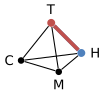
With such simplifications, the geometry of the present example is illustrated in the following figure:

In the above figure, the domain in the annulus sector represents the sealing material, bentonite. A heat power, which is generated by the nuclear waste with one million year variation, is applied onto the inner arc of the annulus sector. On the top boundary, the boundary conditions are $p=4.3 ⋅ 10^6\ \mathrm{Pa}, T=294\ \mathrm{K}$. While on the bottom boundary, the boundary conditions are set as $p=4.7 ⋅ 10^6\ \mathrm{Pa}, T=310\ \mathrm{K}$. The initial conditions are given as $p=4.7 ⋅ 10^6\ \mathrm{Pa}, T=298\ \mathrm{K}$.
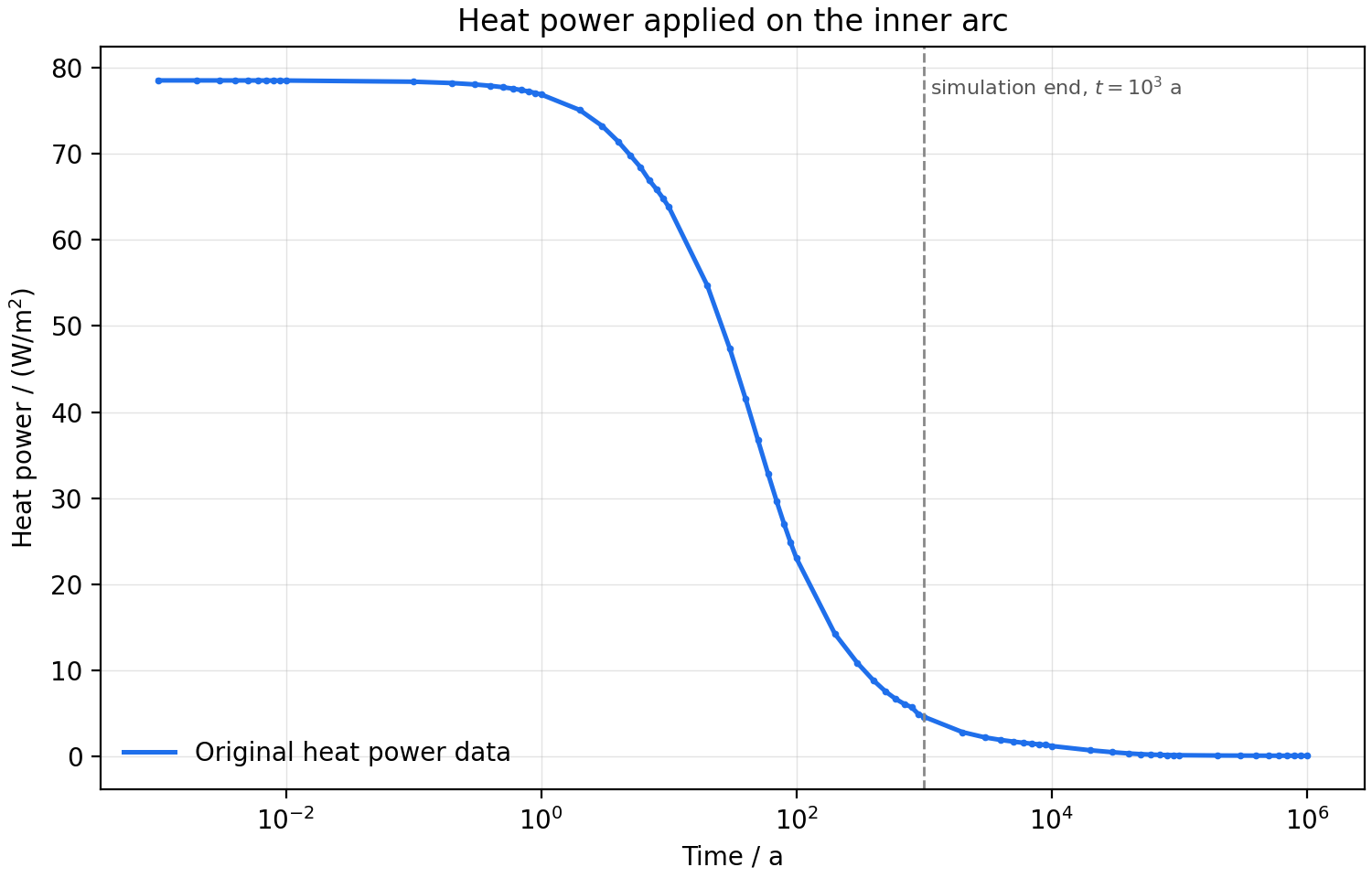
The time variation of that heat power is given by the time_heat_power curve
of the project file, which scales the heat flux on the inner arc.
As shown in the following figure, the curve covers the one million year decay
of the waste, while this benchmark simulates its first 1000 years:
The material properties are shown in the following table in SI units. The project file uses a year as its time unit, which it absorbs into the thermal conductivities and the permeabilities: both appear there multiplied by $31536000\ \mathrm{s}$, so the bentonite conductivity of $1.2\ W/(mK)$ reads $37843200$ and its permeability of $2.0\cdot10^{-21}\ m^2$ reads $6.3072\cdot10^{-14}$. The other values are as tabulated.
| Property | Value | Unit |
|---|---|---|
| Water | ||
| Density | IAPWSIF97Region1 | $kg/m^3$ |
| Viscosity | 10$^{-3}$ | Pa$\cdot$s |
| Thermal conductivity | 0.6 | $W/(mK)$ |
| Specific heat capacity | 4000.0 | $J/(kgK)$ |
| Bentonite | ||
| Density | 1600 | $kg/m^3$ |
| Porosity | 0.41 | - |
| Thermal conductivity | 1.2 | $W/(mK)$ |
| Specific heat capacity | 1.38($T$ - 273.15) + 732.5 | $J/(kgK)$ |
| Saturated permeability | $2.0 \cdot 10^{-21}$ | $m^2$ |
| Solid thermal expansivity | $10^{-5}$ | $K^{-1}$ |
| Biot’s coefficient | 1.0 | $-$ |
| Storage | 0.0 | $Pa^{-1}$ |
| Fractured granite | ||
| Density | 2700 | $kg/m^3$ |
| Porosity | 0.01 | - |
| Thermal conductivity | 3.0 | $W/(mK)$ |
| Specific heat capacity | 900 | $J/(kgK)$ |
| Saturated permeability | $10^{-17}$ | $m^2$ |
| Solid thermal expansivity | $10^{-5}$ | $K^{-1}$ |
| Biot’s coefficient | $1.0$ | $-$ |
| Storage | 0.0 | $Pa^{-1}$ |
Solution
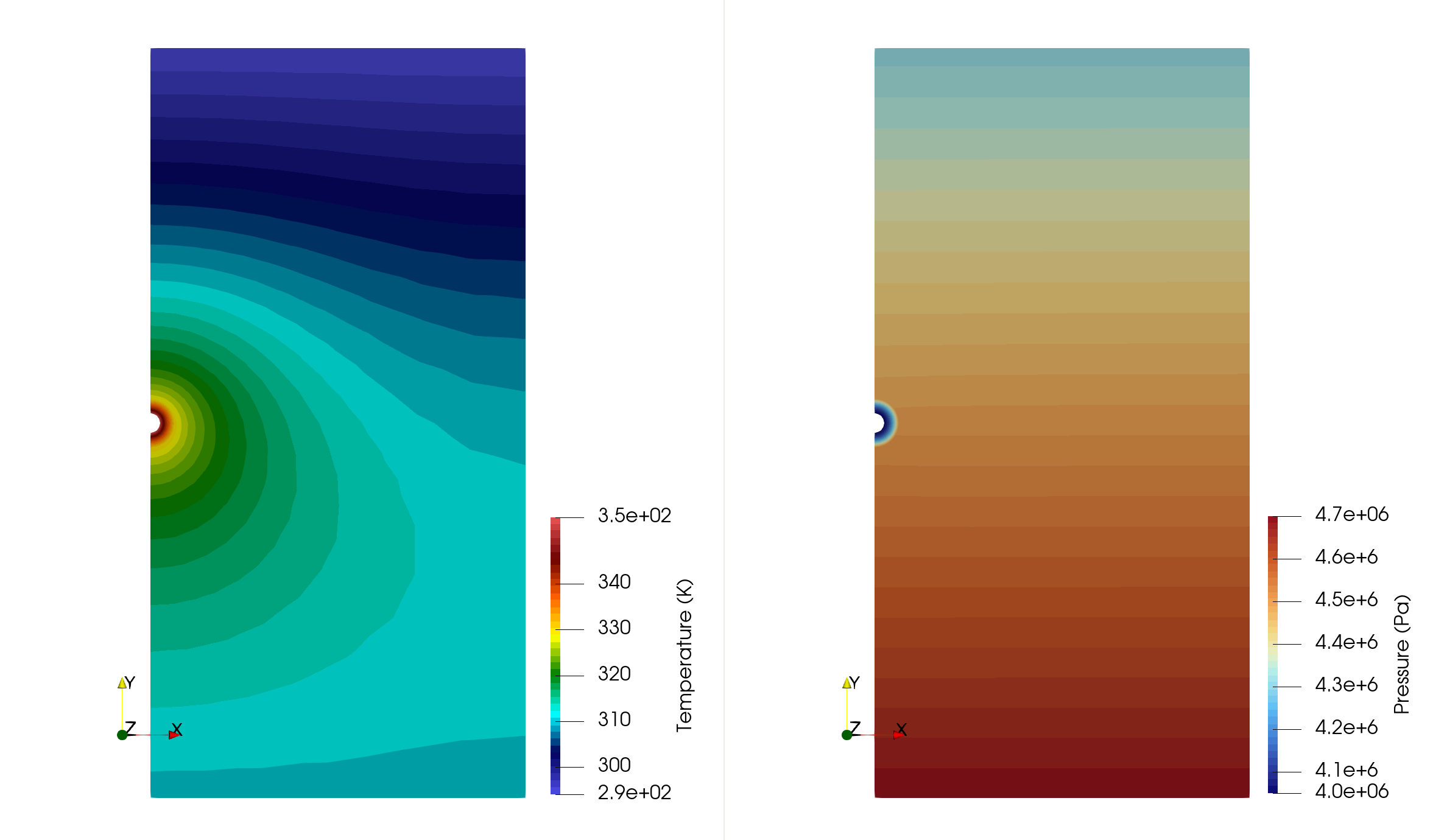
As the reference results, the temperature and pressure distributions in the domain at the time of 18 years are shown in the following figure, in which the thermal convection effective can be seen clearly.
Reference
J. Birkholzer et al. (2008): DECOVALEX-THMC Project, Task D: Long-term permeability/porosity changes in the EDZ and near field due to THM and THC processes in volcanic and crystalline-bentonite systems. No. 2008:45, SKI,@techreport{BirEtAl:2008,
address = {Stockholm},
author = {Birkholzer, J. and Rutqvist, J. and Sonnenthal, E. and Barr, D.},
institution = {SKI},
number = {2008:45},
title = {DECOVALEX-THMC Project, Task D: Long-term permeability/porosity changes in the EDZ and near field due to THM and THC processes in volcanic and crystalline-bentonite systems},
year = {2008}
}
 Community Discussion
The following comments are pulled in from our Discourse forum and contain community-generated content.
This article was written by Wenqing Wang. If you are missing something or you find an error please reach out
to us on our forum.
Generated with Hugo 0.164.0
in CI job 825193
|
Last revision: July 10, 2026
Commit: refactor(HT#CTest): Revise the material data of two benchmarks 7b59773a1
| Edit this page on