Classical transport example: using the full upwind stabilization
Purpose
This example tests the full upwind stabilization scheme, the type name of which
is FullUpwind.
Theory
For the full upwind scheme, we consider the general advection term of the advection diffusion transport equation:
$$ \nabla \cdot ( u \mathbf{v}), $$where $u$ can be temperature $ T$ or mass component concentration $C$, and $\mathbf{v}$ is the fluid velocity. This means $\nabla \cdot \mathbf{v}$ may not be zero, or physically the fluid flow may be compressible.
The discretized weak form of that advection term takes the form
$$ \int_{\Omega_e} \nabla \cdot ( u \mathbf{v}) \phi_i \mathrm{d} \Omega = \int_{\Omega_e} \nabla \cdot ( u \mathbf{v} \phi_i) \mathrm{d} \Omega - \int_{\Omega_e} \nabla \phi_i \cdot ( u \mathbf{v} ) \mathrm{d} \Omega $$with $\phi_i$ the test function. The first term on the right hand side can be converted to boundary integration according to the Green’s theorem as
$$ \int_{\Omega_e} \nabla \cdot ( u \mathbf{v} \phi_i) \mathrm{d} \Omega = \int_{\partial\Omega_e} ( u \mathbf{v} \phi_i) \cdot \mathbf{n} \mathrm{d} \Gamma $$with $\mathbf{n}$ the normal to the boundary surface. That boundary integration is a part of Neumann boundary condition. Therefore what left for the element integration is
$$ -\int_{\Omega_e} \nabla \phi_i \cdot ( u \mathbf{v} ) \mathrm{d} \Omega, $$which is denoted as $R_i$ hereafter.
Based on the scheme introduced by Dalen [1] , the full upwind scheme evaluates the following flux related quantity for each node
$$ q_i = -\int_{\Omega_e} \nabla \phi_i \cdot \mathbf{v} \mathrm{d} \Omega $$to determine whether it is an upwind node. If $q_i>0$, node $i$ is at upwind position.
Let
$$ q_{up} = \sum_{q_i >= 0} q_i u_i $$be the total flux at the upwind nodes, and
$$ q_{down} = \sum_{q_i < 0} q_i $$be the total flux related quantity at the down nodes, we can approximate the discretized weak form of the advection term as:
$$ \begin{eqnarray} R_i \approx \begin{cases} q_i\,u_i,\forall q_i >= 0, \newline q_i \frac{q_{up}}{q_{down}},\forall q_i < 0 \end{cases} = \begin{cases} q_i\,u_i,\forall q_i \>= 0\newline \frac{1}{q_{down}} q_i {\sum_{q_j >= 0} (q_j u_j)},\forall q_i < 0 \end{cases}=\tilde R_i. \end{eqnarray} $$The above approximation defines the full upwind scheme of the advection term of the advection diffusion transport equation for the FEM analysis. Obviously, we see that
$$ \begin{eqnarray} \sum_i \tilde R_i &=& \sum_{q_i >= 0} q_i u_i + \sum_{q_i < 0} \frac{1}{q_{down}} q_i {\sum_{q_j >= 0} (q_j u_j)}\newline &=& \sum_{q_i >= 0} q_i u_i + \frac{\sum_{q_i < 0} q_i}{q_{down}} {\sum_{q_j >= 0} (q_j u_j)} = q_{up}-q_{up} = 0, \end{eqnarray} $$which means that the nodal mass balance of element is guaranteed.
Example and its results
The example is described in Classical transport example: using the isotropic diffusion stabilization .
The following two figures compare the example results with the analytical solution
and that are obtained by using the isotropic diffusion stabilization.
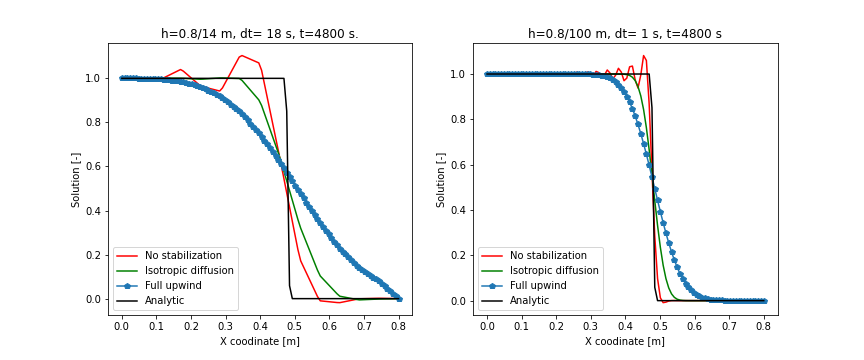
From the figures we can see that the full upwind scheme adds more diffusion than the isotropic diffusion scheme does.
Reference
[1] Dalen, V., 1979. Simplified finite-element models for reservoir flow problems. Society of Petroleum Engineers Journal, 19(05), pp.333-343.
 Community Discussion
The following comments are pulled in from our Discourse forum and contain community-generated content.
This article was written by Wenqing Wang. If you are missing something or you find an error please reach out
to us on our forum.
Generated with Hugo 0.164.0
in CI job 825193
|
Last revision: April 20, 2026
Commit: refactor(MeshLib): remove PropertyVector::push_back 870422dde
| Edit this page on