·
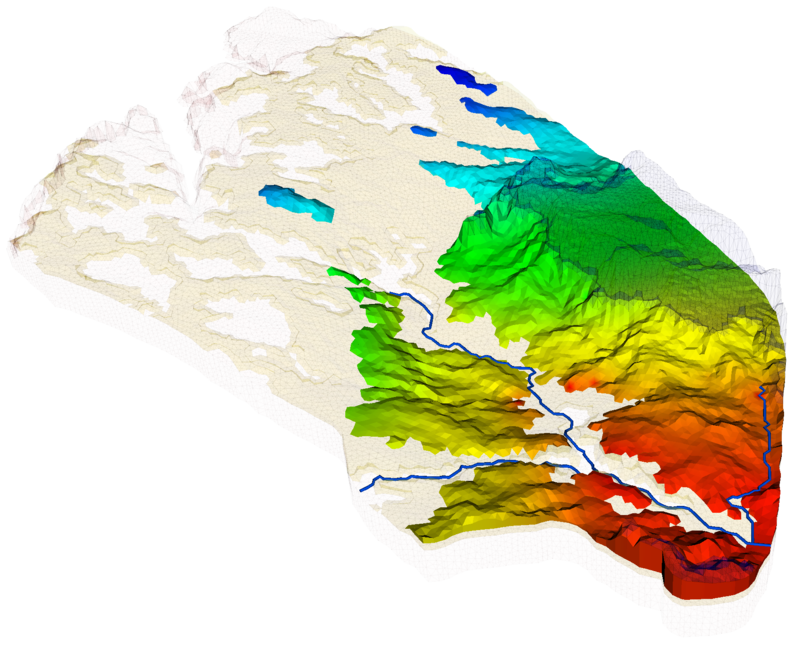
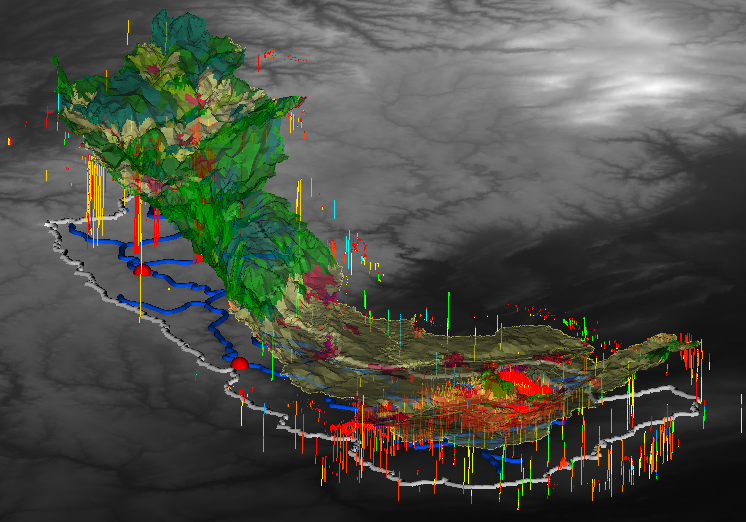
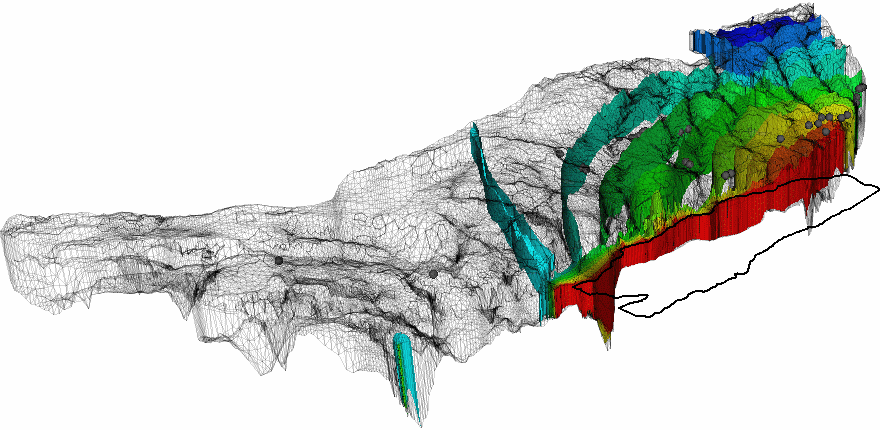
The same simulation framework underpins research questions across the geosciences — three of the most active fields are shown below.
From regional groundwater flow to contaminant and coastal transport, OGS resolves how water and solutes move through complex subsurface domains.

Model heat extraction and storage in the deep subsurface, capturing the coupled thermal, hydraulic and mechanical response of geothermal reservoirs.

Assess deep geological repositories over long timescales, resolving the full THMC evolution of the host rock and engineered barrier system.
An adaptable, modular architecture enabling a wide variety of use cases and flexible research workflows.
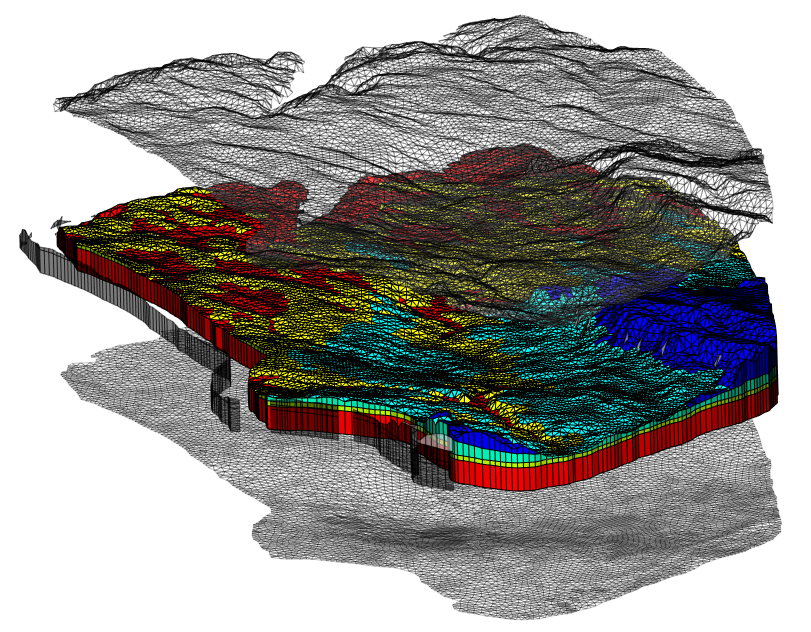
Convert data sets, build and analyse meshes, and parametrize models with boundary conditions and source terms.
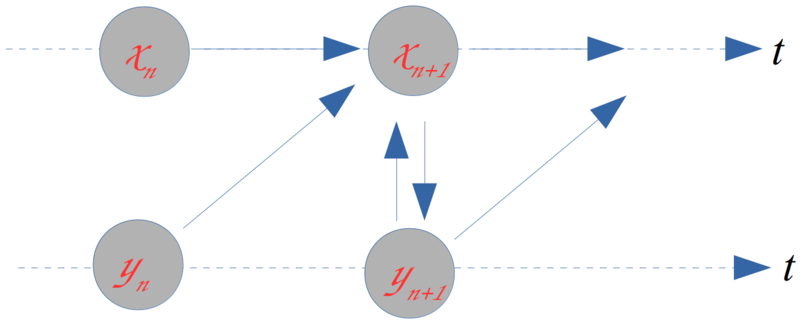
Solve coupled systems monolithically or with the staggered scheme for thermo-hydraulic, hydro-mechanical and phase-field problems.
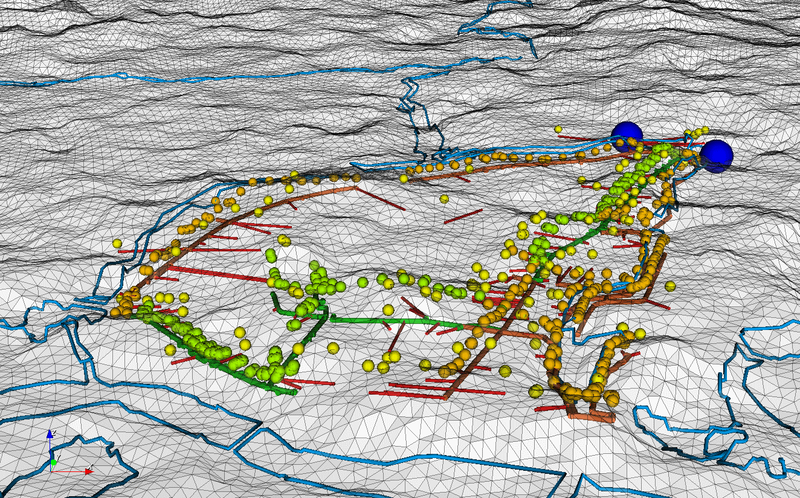
Assess, integrate and visualize data sets with the OGS Data Explorer to catch artefacts and inconsistencies early.
Standard VTK output integrates directly with ParaView and VR-enabled visualization for intuitive exploration.
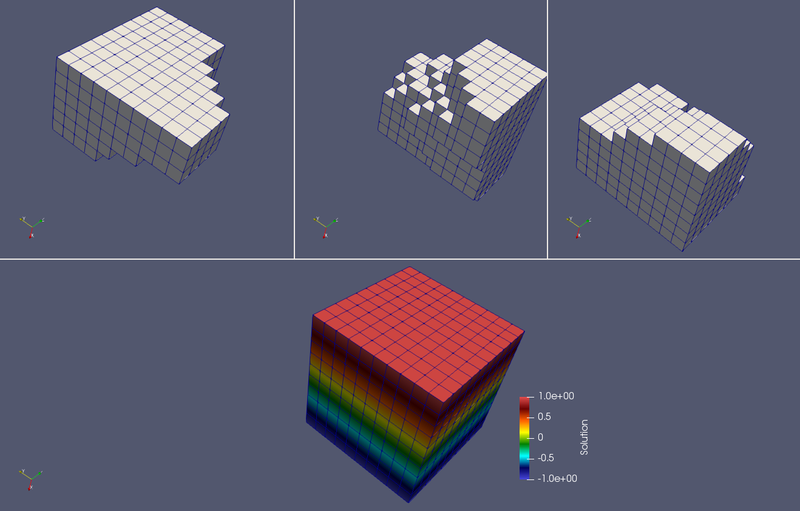
Domain-decomposition parallelism built on PETSc and MPI scales across a wide variety of HPC architectures.
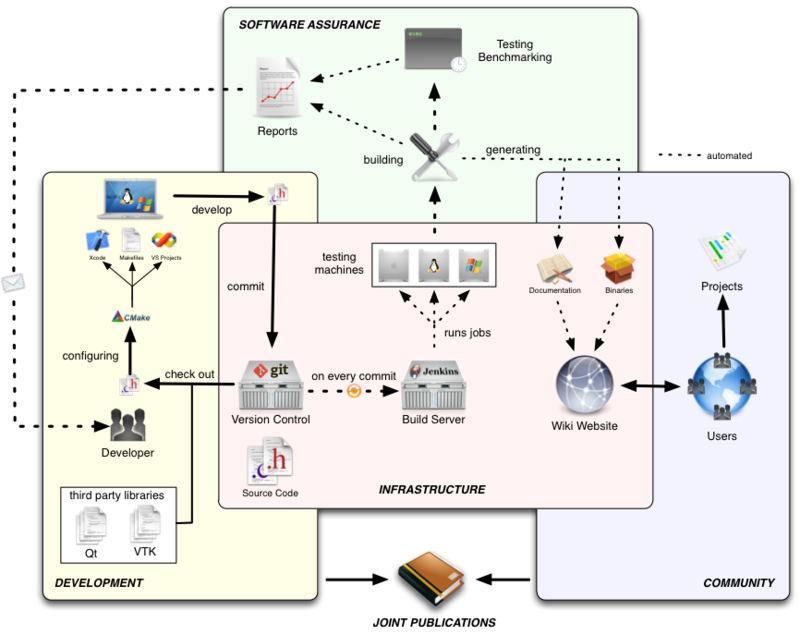
A community-driven, fully open workflow with automated CI testing and mentored code review for every contribution.
The tools above are not isolated — they chain into a single reproducible pipeline. Every stage reads and writes open, standard formats, so a model flows from raw field data to published results without ever leaving the OGS ecosystem.
Field measurements, geological models and geometry imported into OGS data formats.
Build and refine meshes, then assign material parameters, boundary conditions and source terms.
Solve THMC processes monolithically or staggered, in parallel on HPC through PETSc and MPI.
Export VTK for ParaView and VR — analysis, verification and publication-ready figures.
In this paper, we present a Python-based software package that enables the conversion of numerical models from FEFLOW, a commercial groundwater flow, mass and heat transport modelling software, to OpenGeoSys, an open-source software for the simulation of thermo-hydro-mechanical-chemical (THMC) processes in porous and fractured media. This converter enhances interoperability in complex workflows for environmental geotechnics, as multiple software packages are now available for use at different stages of the workflow, thus combining their individual capabilities. We verify the software's correct implementation with various test cases that cover the converter's entire feature set: different physical processes, various boundary conditions, and source terms. The conversion software permits the modification of FEFLOW models post-conversion, which we demonstrate with a real-world example. The converter offers flexibility that extends beyond the modelling approaches in FEFLOW by allowing the use of OGS features. Thereby, it is possible to combine the advantages of FEFLOW, such as the model setup capabilities, with simulations of processes that only OGS supports. The presented software enables users to convert FEFLOW models to widely used open formats such as VTK and XML, fostering collaboration in research and application projects. Furthermore, using an open-source code like OpenGeoSys for simulations enhances the transparency. Geological models of porous and fractured media in open-source formats facilitate the transfer of data and knowledge within large research initiatives, particularly in complex domains such as nuclear waste management.
Proper understanding and handling of uncertainties is critical for the development of safe and reliable facilities for long-term storage of nuclear waste. To prove their safety, numerical simulations are commonly used. They are based on models including physical processes, constitutive assumptions, material parameters, etc. Numerical simulations only approximate the observed reality. Among sources for this mismatch between observations and simulation results are uncertainties in selecting a correct model of the physical processes taking place in the subsurface and uncertainties in parameter values. The impact they can have on the results of the numerical simulations and conclusions drawn from them can be significant and needs to be explored to improve the trust in demonstrations of safety derived from models and numerical simulations. In this study, this will be done by a joint investigation of uncertainties originating from process model selection and parameter calibration. Existing literature suggests a potentially significant impact of thermo-osmosis (TO) on pore pressure evolution as a result of thermal gradients in clay rocks around nuclear waste canisters. In this study, different process models will be confronted with the common belief that more complex models (with more degrees of freedom) will always yield a better match with data. In this perspective, it could be argued that expanding the physical process with TO can be abused for parameter tweaking, leading to overfitting the observed data independent of physical adequacy. To disprove this, uncertainty quantification and sensitivity analysis methods will be applied to test the impact of multiple combinations of assumptions about physical process, relevance of TO and model parameter values to show that it may not necessarily be the most complex model that will represent the observed data best in a plausible manner.
We compare two-phase flow and Richards flow implementations in OpenGeoSys-6 to model the thermo-hydro-mechanical evolution of heat-emitting waste in clay stone formations. Our quasi-1D example is based on the material sequence and domain properties observed in the FE experiment at the Mt. Terri underground research lab in Switzerland. We examine the validity of the Richards assumption by comparing a thermo-hydro-mechanically (THM) coupled Richards model against two THM-coupled two-phase flow-based models, one where the gas pressure is constrained to atmospheric pressure, and one unconstrained model. The model comparison was conducted with saturation-dependent permeability models at temperatures up to ≈200 °C. Additionally, we consider the impact of two different vapor diffusion models, a gas pressure–independent empirical relationship versus the original De Vries model, which becomes relevant if gas pressure buildup is significant. Our results show excellent agreement between the two models for maximum temperatures around 100∘. Even at higher temperatures, above 150 °C, we observe good agreement, which improves significantly with increasing distance from the heater. Even for the highest heat power where both approaches differ significantly in the high-temperature regions, acceptable agreement can be reached outside those regions, i.e. a couple of tens of centimeters away from the heater, but still in the bentonite barrier domain. This work builds confidence in the use of Richards-based approaches for modeling of the THM processes in nuclear waste repository, and contributes to a knowledge-driven model selection in the context of safety-relevant radioactive waste management.
Start by downloading a prebuilt package for your platform and running the benchmarks.
Download →Obtain the source, configure your toolchain and build the application from the Developer Guide.
Developer Guide →Get in touch through the Discourse forum, GitLab or email — every contribution is welcome.
Discussion forum →