EURAD-DONUT
Development and improvement of numerical methods and tools for modelling coupled processes
DONUT’s purpose is to improve and develop methods and numerical tools to advance the development of relevant, high-performance, cutting-edge numerical methods that can easily be implemented in existing or new tools. This will facilitate the study of highly coupled processes in large systems and numerical scale transition schemes for coupled processes, as well as providing innovative numerical methods for uncertainty and sensitivity analyses (Claret et al., 2024; Churakov et al., 2024). DONUT paved the way for the analysis of complex field experiments in URLs (e.g. the FE experiment, Kaiser et al., 2025) and the simulation of complete repository systems (e.g. gas transport in LILW repositories, Pitz et al., 2026). Within the DONUT framework, novel numerical schemes have been developed and tested against benchmarks, forming the link to the ModelHub.
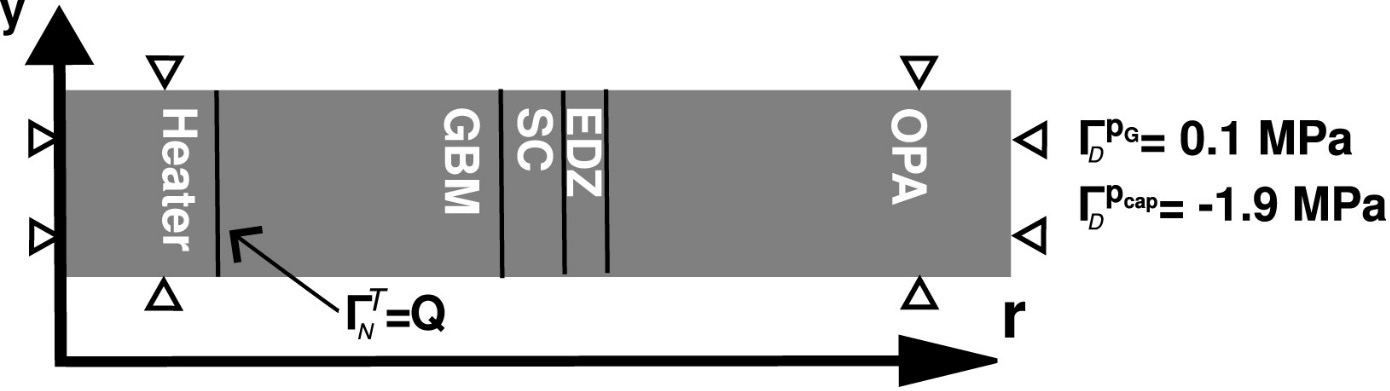
Schematic of the buffer structure of the FE experiment (Buchwald et al. 2025)
References
-
Renchao Lu et al.
(2022):
A new operator-splitting finite element scheme for reactive transport modeling in saturated porous media.
Computers & Geosciences,
vol. 163,
p. 105106,
DOI:10.1016/j.cageo.2022.105106
@article{lu2022, author = {Renchao Lu and Thomas Nagel and Jenna Poonoosamy and Dmitri Naumov and Thomas Fischer and Vanessa Montoya and Olaf Kolditz and Haibing Shao}, category = {Methods}, doi = {10.1016/j.cageo.2022.105106}, issn = {0098-3004}, journal = {Computers & Geosciences}, key = {lu2022}, keywords = {Reactive transport modeling, Operator splitting approach, Integration-point collocation scheme}, pages = {105106}, title = {A new operator-splitting finite element scheme for reactive transport modeling in saturated porous media}, volume = {163}, year = {2022} } -
S. V. Churakov et al.
(2024):
Position paper on high fidelity simulations for coupled processes, multi-physics and chemistry in geological disposal of nuclear waste.
Environmental Earth Sciences,
No. 17,
vol. 83,
p. 521,
DOI:10.1007/s12665-024-11832-7,
Publisher link
@article{Churakov2024, author = {Churakov, S. V. and Claret, F. and Idiart, A. and Jacques, D. and Govaerts, J. and Kolditz, O. and Prasianakis, N. I. and Samper, J.}, doi = {10.1007/s12665-024-11832-7}, journal = {Environmental Earth Sciences}, number = {17}, pages = {521}, title = {Position paper on high fidelity simulations for coupled processes, multi-physics and chemistry in geological disposal of nuclear waste}, url = {https://link.springer.com/article/10.1007/s12665-024-11832-7}, volume = {83}, year = {2024} } -
F. Claret et al.
(2024):
EURAD state-of-the-art report: development and improvement of numerical methods and tools for modeling coupled processes in the field of nuclear waste disposal.
Frontiers in Nuclear Engineering,
vol. 3,
p. 1437714,
DOI:10.3389/fnuen.2024.1437714
@article{Claret2024, author = {Claret, F. and Prasianakis, N. I. and Baksay, A. and Lukin, D. and Pepin, G. and Ahusborde, E. and Amaziane, B. and Bátor, G. and Becker, D. and Bednár, A. and Béreš, M. and Bérešová, S. and Böthi, Z. and Brendler, V. and Brenner, K. and Březina, J. and Chave, F. and Churakov, S. V. and Hokr, M. and Horák, D. and Jacques, D. and Jankovský, F. and Kazymyrenko, C. and Koudelka, T. and Kovács, T. and Krejčí, T. and Kruis, J. and Laloy, E. and Landa, J. and Ligurský, T. and Lipping, T. and López-Vázquez, C. and Masson, R. and Meeussen, J. C. L. and Mollaali, M. and Mon, A. and Montenegro, L. and Pisani, B. and Poonoosamy, J. and Pospiech, S. I. and Saâdi, Z. and Samper, J. and Samper-Pilar, A.-C. and Scaringi, G. and Sysala, S. and Yoshioka, K. and Yang, Y. and Zuna, M. and Kolditz, O.}, doi = {10.3389/fnuen.2024.1437714}, journal = {Frontiers in Nuclear Engineering}, pages = {1437714}, title = {EURAD state-of-the-art report: development and improvement of numerical methods and tools for modeling coupled processes in the field of nuclear waste disposal}, url = {https://doi.org/10.3389/fnuen.2024.1437714}, volume = {3}, year = {2024} } -
Jörg Buchwald et al.
(2025):
The relevance of two-phase flow in the thermo-hydro-mechanical evolution of clay formations exposed to high temperatures by heat-emitting waste.
Applied Thermal Engineering,
vol. 264,
p. 125379,
DOI:10.1016/j.applthermaleng.2024.125379,
Publisher link
@article{buchwald2025, abstract = {We compare two-phase flow and Richards flow implementations in OpenGeoSys-6 to model the thermo-hydro-mechanical evolution of heat-emitting waste in clay stone formations. Our quasi-1D example is based on the material sequence and domain properties observed in the FE experiment at the Mt. Terri underground research lab in Switzerland. We examine the validity of the Richards assumption by comparing a thermo-hydro-mechanically (THM) coupled Richards model against two THM-coupled two-phase flow-based models, one where the gas pressure is constrained to atmospheric pressure, and one unconstrained model. The model comparison was conducted with saturation-dependent permeability models at temperatures up to ≈200 °C. Additionally, we consider the impact of two different vapor diffusion models, a gas pressure–independent empirical relationship versus the original De Vries model, which becomes relevant if gas pressure buildup is significant. Our results show excellent agreement between the two models for maximum temperatures around 100∘. Even at higher temperatures, above 150 °C, we observe good agreement, which improves significantly with increasing distance from the heater. Even for the highest heat power where both approaches differ significantly in the high-temperature regions, acceptable agreement can be reached outside those regions, i.e. a couple of tens of centimeters away from the heater, but still in the bentonite barrier domain. This work builds confidence in the use of Richards-based approaches for modeling of the THM processes in nuclear waste repository, and contributes to a knowledge-driven model selection in the context of safety-relevant radioactive waste management.}, author = {Jörg Buchwald and Norbert Grunwald and Wenqing Wang and Hua Shao and Olaf Kolditz and Thomas Nagel}, doi = {https://doi.org/10.1016/j.applthermaleng.2024.125379}, issn = {1359-4311}, journal = {Applied Thermal Engineering}, keywords = {Coupled thermo-hydro-mechanical processes, Non-isothermal two-component two-phase flow, Non-isothermal Richards equation, Nuclear waste disposal, OpenGeoSys}, pages = {125379}, title = {The relevance of two-phase flow in the thermo-hydro-mechanical evolution of clay formations exposed to high temperatures by heat-emitting waste}, url = {https://www.sciencedirect.com/science/article/pii/S1359431124030473}, volume = {264}, year = {2025} } -
Sonja Kaiser et al.
(2025):
Differential assessment of effects of increasing model complexity in THM coupled models of the FE experiment at Mt. Terri.
Geomechanics for Energy and the Environment,
vol. 42,
p. 100637,
DOI:10.1016/j.gete.2025.100637,
Publisher link
@article{Kaiser2025, author = {Kaiser, Sonja and Wang, Wenqing and Buchwald, Jörg and Naumov, Dmitri and Chaudhry, A. A. and Nagel, Thomas}, doi = {10.1016/j.gete.2025.100637}, journal = {Geomechanics for Energy and the Environment}, pages = {100637}, title = {Differential assessment of effects of increasing model complexity in THM coupled models of the FE experiment at Mt. Terri}, url = {https://www.sciencedirect.com/science/article/pii/S2352380825000024}, volume = {42}, year = {2025} } -
Michael Pitz et al.
(2026):
A numerical large-scale investigation of gas transport processes in a generic nuclear waste repository in argillaceous porous media.
Environmental Earth Sciences,
No. 7,
vol. 85,
p. 191,
DOI:10.1007/s12665-026-12895-4,
Publisher link
@article{Pitz2026,
 author = {Pitz, Michael and Ziefle, Gesa and Kunz, Herbert and Nagel, Thomas and Grunwald, Norbert and Maßmann, Jobst},
 doi = {10.1007/s12665-026-12895-4},
 journal = {Environmental Earth Sciences},
 number = {7},
 pages = {191},
 title = {A numerical large-scale investigation of gas transport processes in a generic nuclear waste repository in argillaceous porous media},
 url = {https://link.springer.com/article/10.1007/s12665-026-12895-4},
 volume = {85},
 year = {2026}
}