Publications

If you find OpenGeoSys useful for your research please cite us!

Cite the software

Publications

GeomInt: geomechanical integrity of host and barrier rocks–experiments, models and analysis of discontinuities
O Kolditz et al. · 2021 · Env Earth Sci

GeomInt: geomechanical integrity of host and barrier rocks–experiments, models and analysis of discontinuities

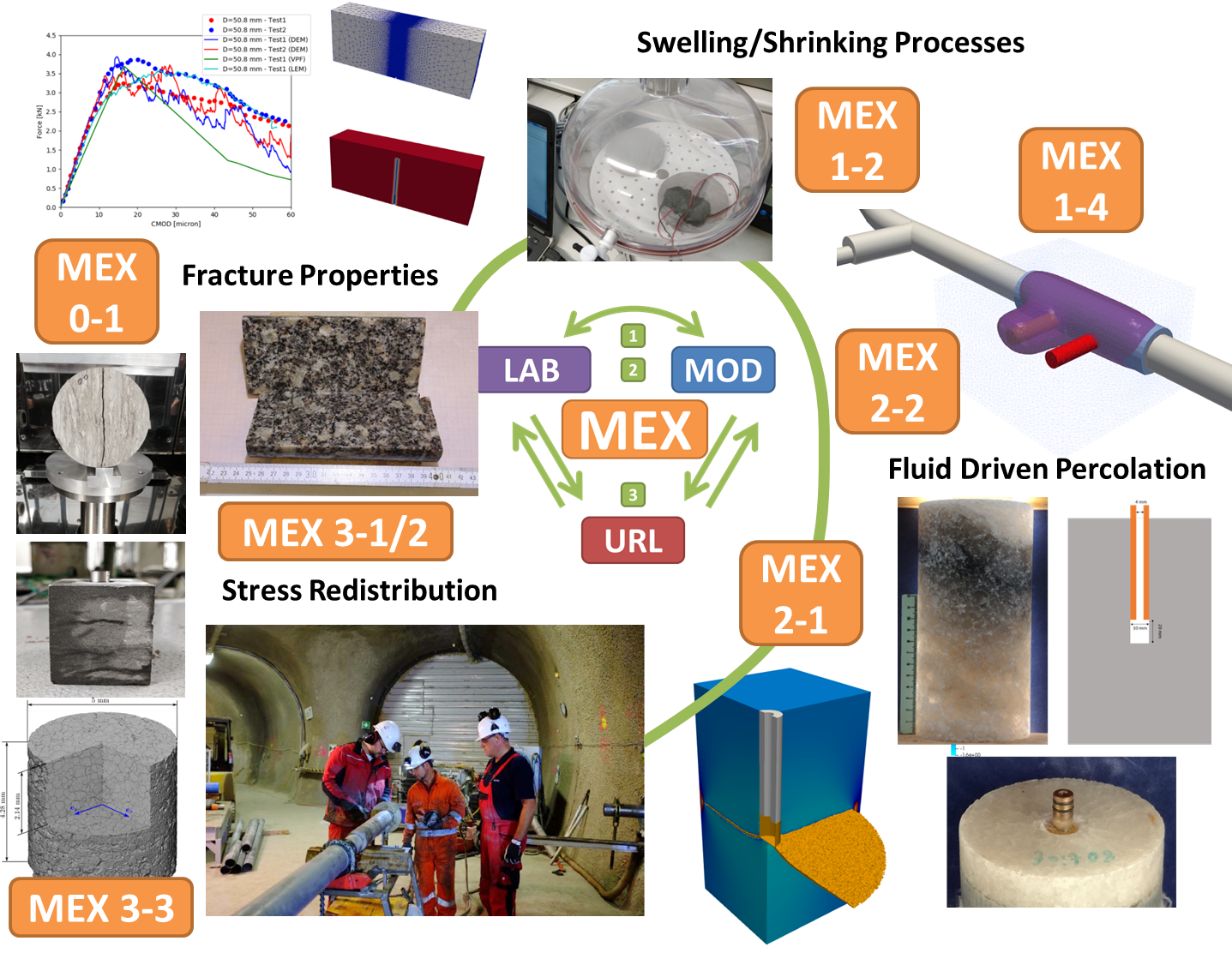
The present paper gives an overview of the GeomInt project “Geomechanical integrity of host and barrier rocks – experiment, modelling and analysis of discontinuities” which has been conducted from 2017–2020 within the framework of the “Geo:N Geosciences for Sustainability” program. The research concept of the collaborative project is briefly introduced followed by a summary of the most important outcomes. The research concept puts geological discontinuities into the centre of investigations – as these belong to the most interesting and critical elements for any subsurface utilisation. Thus, while research questions are specific, they bear relevance to a wide range of applications. The specific research is thus integrated into a generic concept in order to make the results more generally applicable and transferable. The generic part includes a variety of conceptual approaches and their numerical realisations for describing the evolution of discontinuities in the most important types of barrier rocks. An explicit validation concept for the generic framework was developed and realised by specific “model-experiment-exercises” (MEX) which combined experiments and models in a systematic way from the very beginning. 16 MEX have been developed which cover a wide range of fundamental fracturing mechanisms, i.e. swelling/shrinkage, fluid percolation, and stress redistribution processes. The progress in model development is also demonstrated by field-scale applications, e.g. in the analysis and design of experiments in underground research laboratories in Opalinus Clay (URL Mont Terri, Switzerland) and salt rock (research mine Springen, Germany).
Analysis of coupled thermal-hydro-mechanical processes in Callovo-Oxfordian clay rock: From full-scale experiments to the repository scale
W Wang et al. · 2021 · Eng Geol

Analysis of coupled thermal-hydro-mechanical processes in Callovo-Oxfordian clay rock: From full-scale experiments to the repository scale

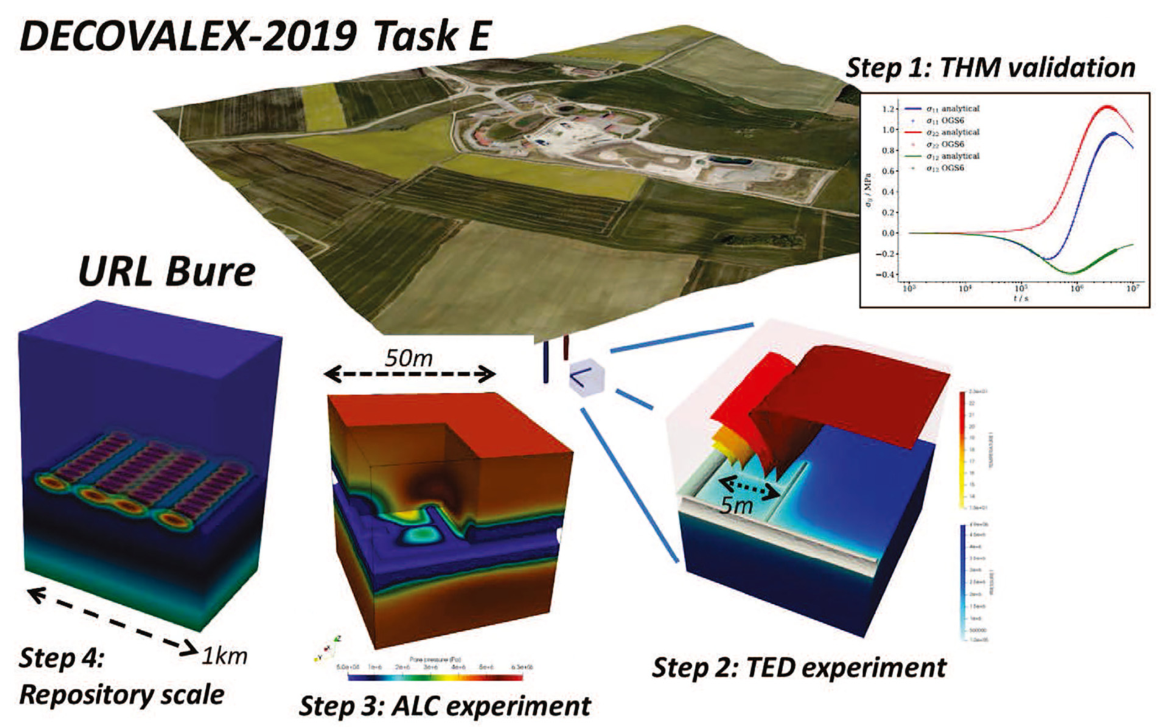
Management of energy waste such as high-level waste (HLW) disposal in deep geological repositories is one of most pressing challenges in the context of nuclear energy. The general research question addressed in the present work is how to represent coupled physical processes after the emplacement of heat-emitting waste in such a repository in claystone at multiple scales by numerical models and how can they validated by experimental results in underground research laboratories. Numerical modelling of the coupled thermal hydraulic mechanical (THM) processes to assess the long-term safety of deep geological repositories rests on adequate constitutive laws and quantification of in-situ host rock material properties during long-term heating as well as a reliable nu- merical approach for solving the underlying governing equations. For this purpose, various in-situ experiments have been conducted in the Callovo-Oxfordian claystone (COx) at the Meuse/Haute-Marne (M/HM) Under- ground Research Laboratory (URL) by the French National Radioactive Waste Management Agency (ANDRA) since 2003. A subset of these is investigated here using a numerical THM model employed at different spatial scales. Two main results were achieved. First, the previously developed numerical THM model (Wang et al., 2021) has been compared agains in-situ experimental data from the full-scale heating (ALC) experiment at the M/HM URL in an attempt to validate the model. The numerically simulated temperature and pore pressure data of the ALC experiment are in good agreement with in-situ measured data. This model was then employed to simulate fully coupled THM processes of an entire repository section for High-Level Waste (HLW) in a COx clay formation according to the Cigeo project by ANDRA. This upscaling was enabled by running the numerical code on high-performance-computing platforms. Three-dimensional, fully coupled and efficient THM models for the numerical simulation of deep geological repositories such as the one presented in this study will help in the design of nuclear waste repositories under realistic geological conditions. Moreover, the present work is a contribution to Task E of the DECOVALEX-2019 project for model validation and comparison against experi- mental results (Plúa et al., 2021; Seyedi et al., 2020).