2025 · International Journal of Rock Mechanics and Mining Sciences
Is more always better? Study on uncertainties introduced by decision-making process of model design — A case study with thermo-osmosis
Feliks K. Kiszkurno, Jörg Buchwald, Christian B. Silberman, Olaf Kolditz, Thomas Nagel
Abstract
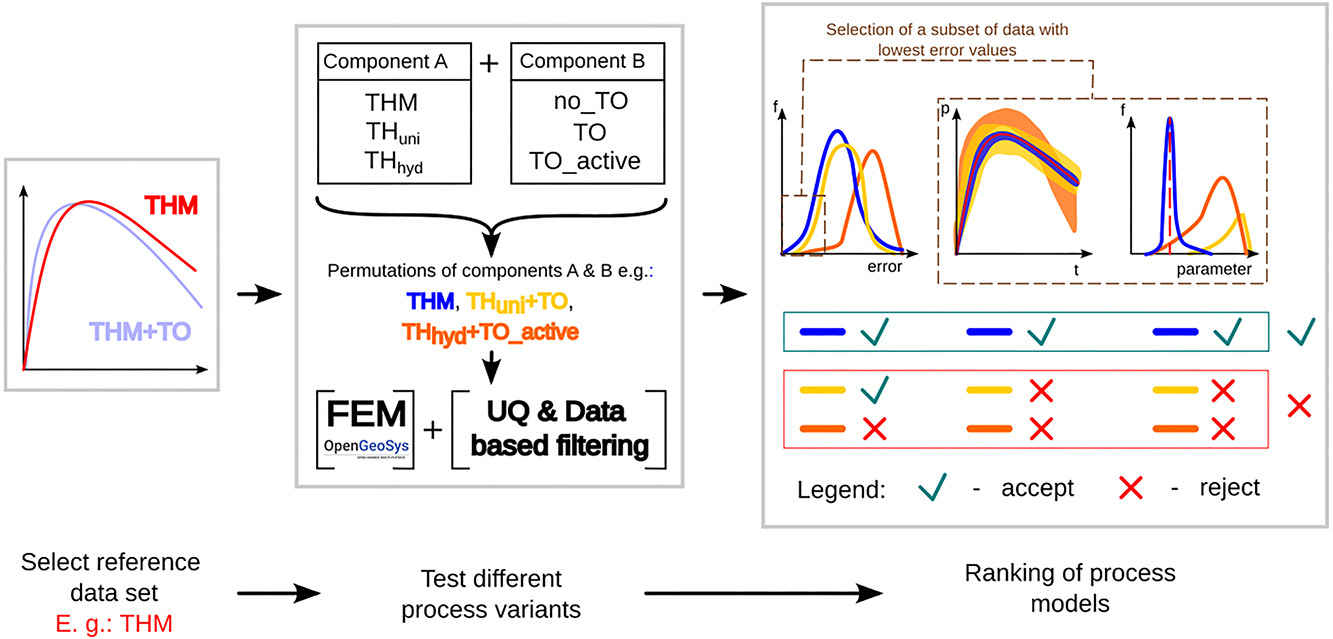
Proper understanding and handling of uncertainties is critical for the development of safe and reliable facilities for long-term storage of nuclear waste. To prove their safety, numerical simulations are commonly used. They are based on models including physical processes, constitutive assumptions, material parameters, etc. Numerical simulations only approximate the observed reality. Among sources for this mismatch between observations and simulation results are uncertainties in selecting a correct model of the physical processes taking place in the subsurface and uncertainties in parameter values. The impact they can have on the results of the numerical simulations and conclusions drawn from them can be significant and needs to be explored to improve the trust in demonstrations of safety derived from models and numerical simulations. In this study, this will be done by a joint investigation of uncertainties originating from process model selection and parameter calibration. Existing literature suggests a potentially significant impact of thermo-osmosis (TO) on pore pressure evolution as a result of thermal gradients in clay rocks around nuclear waste canisters. In this study, different process models will be confronted with the common belief that more complex models (with more degrees of freedom) will always yield a better match with data. In this perspective, it could be argued that expanding the physical process with TO can be abused for parameter tweaking, leading to overfitting the observed data independent of physical adequacy. To disprove this, uncertainty quantification and sensitivity analysis methods will be applied to test the impact of multiple combinations of assumptions about physical process, relevance of TO and model parameter values to show that it may not necessarily be the most complex model that will represent the observed data best in a plausible manner.
Authors
Feliks K. Kiszkurno, Jörg Buchwald, Christian B. Silberman, Olaf Kolditz, Thomas Nagel
Details
- Year
- 2025
- Journal
- International Journal of Rock Mechanics and Mining Sciences
- Citation key
kiszkurno2025
@article{kiszkurno2025,
 abstract = {Proper understanding and handling of uncertainties is critical for the development of safe and reliable facilities for long-term storage of nuclear waste. To prove their safety, numerical simulations are commonly used. They are based on models including physical processes, constitutive assumptions, material parameters, etc. Numerical simulations only approximate the observed reality. Among sources for this mismatch between observations and simulation results are uncertainties in selecting a correct model of the physical processes taking place in the subsurface and uncertainties in parameter values. The impact they can have on the results of the numerical simulations and conclusions drawn from them can be significant and needs to be explored to improve the trust in demonstrations of safety derived from models and numerical simulations. In this study, this will be done by a joint investigation of uncertainties originating from process model selection and parameter calibration. Existing literature suggests a potentially significant impact of thermo-osmosis (TO) on pore pressure evolution as a result of thermal gradients in clay rocks around nuclear waste canisters. In this study, different process models will be confronted with the common belief that more complex models (with more degrees of freedom) will always yield a better match with data. In this perspective, it could be argued that expanding the physical process with TO can be abused for parameter tweaking, leading to overfitting the observed data independent of physical adequacy. To disprove this, uncertainty quantification and sensitivity analysis methods will be applied to test the impact of multiple combinations of assumptions about physical process, relevance of TO and model parameter values to show that it may not necessarily be the most complex model that will represent the observed data best in a plausible manner.},
 author = {Feliks K. Kiszkurno and Jörg Buchwald and Christian B. Silberman and Olaf Kolditz and Thomas Nagel},
 doi = {https://doi.org/10.1016/j.ijrmms.2025.106075},
 issn = {1365-1609},
 journal = {International Journal of Rock Mechanics and Mining Sciences},
 keywords = {Numerical modeling, Nuclear waste storage, THM process, Thermo-osmosis},
 pages = {106075},
 title = {Is more always better? Study on uncertainties introduced by decision-making process of model design — A case study with thermo-osmosis},
 url = {https://www.sciencedirect.com/science/article/pii/S1365160925000528},
 volume = {189},
 year = {2025}
}