OpenWorkFlow
Synthesis platform for the German site selection
According to the German Site Selection Act (StandAG), the objective is to identify the site that provides the highest possible level of safety for a repository for high-level radioactive waste in Germany. To this end, safety assessments are conducted for a period of one million years, among other measures. Many of the analyses required for these assessments, in turn, rely on numerical simulations of the physical, chemical, and biological processes occurring within a repository and its surroundings.
An important project objective is the development of prototype models for potential repositories/site regions. These consist of linked numerical models whose key outputs are safety-relevant quantities, such as material/mass releases, fluid pressure, dilatancy, and temperature. The prototype models differ for the individual host rocks—clay rock, rock salt, and crystalline rock. They serve as blueprints and can be readily adapted to specific site regions. To achieve this project objective, OpenWorkFlow is developing a numerical toolbox for safety assessments that covers tasks such as data integration, model creation, model execution, post-processing, and archiving.
Both the development process and its outcome (the synthesis platform) encompass a broad range of scientific and technical aspects and are subject to a number of quality criteria, which are described in more detail in the following sections.
More information can be found on the OpenWorkFlow web site (in German only).
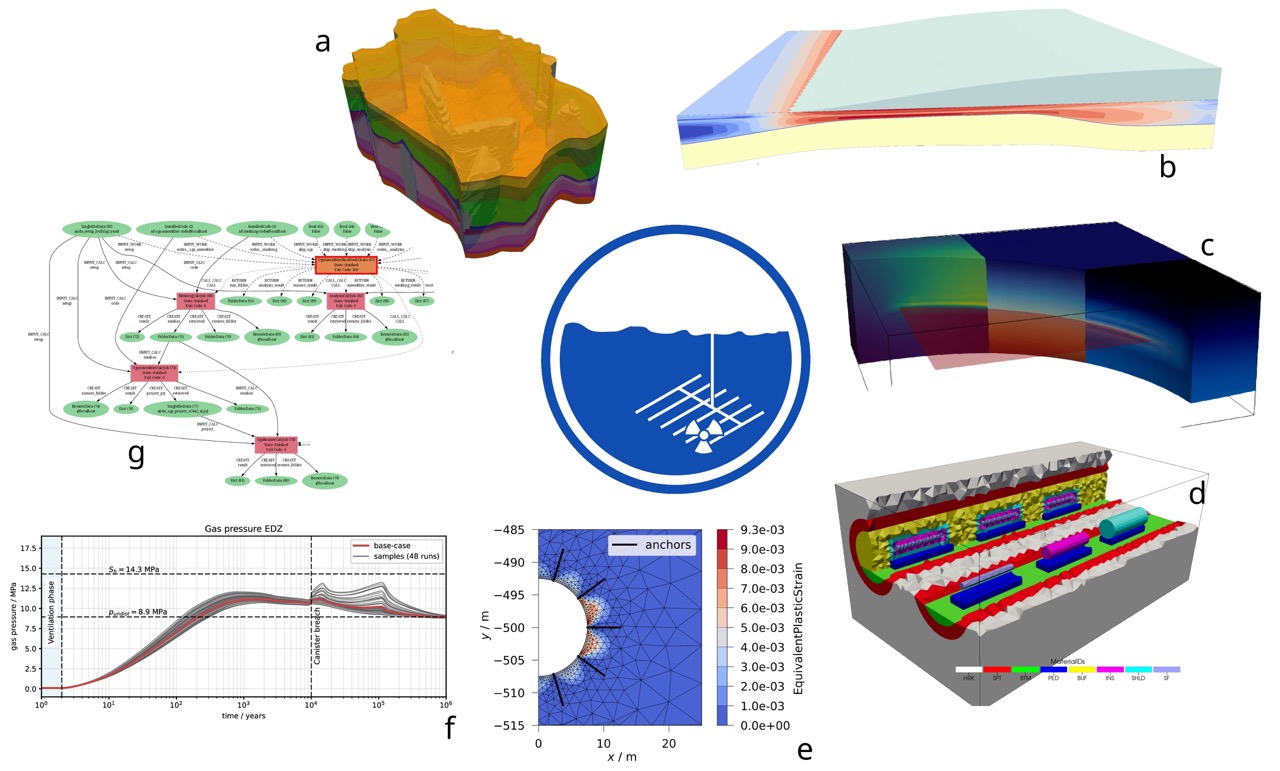
Schematic representation of key aspects of the developed simulation workflows, shown clockwise. a: Integration of (geological) data into computational models. b: Simulation of FEPs (here: glaciation). c: Coupled thermal, hydraulic, mechanical, and chemical processes in the far field. d: Relevant geometries in the near field—fuel assemblies, canisters, host rock, etc. e: Analysis of geotechnical support systems—grouted anchors. f: Near-field integrity analysis—gas pressure increase due to canister corrosion for different parameter sets. g: Tracing the execution graph of a workflow using the provenance database.
References
-
J Heinze et al.
(2025):
Combining FEFLOW and OpenGeoSys for interoperable workflows.
Environ Earth Sci,
vol. 84,
p. art.~457,
DOI:10.1007/s12665-025-12380-4
@article{Heinze2025, abstract = {In this paper, we present a Python-based software package that enables the conversion of numerical models from FEFLOW, a commercial groundwater flow, mass and heat transport modelling software, to OpenGeoSys, an open-source software for the simulation of thermo-hydro-mechanical-chemical (THMC) processes in porous and fractured media. This converter enhances interoperability in complex workflows for environmental geotechnics, as multiple software packages are now available for use at different stages of the workflow, thus combining their individual capabilities. We verify the software's correct implementation with various test cases that cover the converter's entire feature set: different physical processes, various boundary conditions, and source terms. The conversion software permits the modification of FEFLOW models post-conversion, which we demonstrate with a real-world example. The converter offers flexibility that extends beyond the modelling approaches in FEFLOW by allowing the use of OGS features. Thereby, it is possible to combine the advantages of FEFLOW, such as the model setup capabilities, with simulations of processes that only OGS supports. The presented software enables users to convert FEFLOW models to widely used open formats such as VTK and XML, fostering collaboration in research and application projects. Furthermore, using an open-source code like OpenGeoSys for simulations enhances the transparency. Geological models of porous and fractured media in open-source formats facilitate the transfer of data and knowledge within large research initiatives, particularly in complex domains such as nuclear waste management.}, author = {J Heinze and C Lehmann and T Meisel and K Rink and P Kreye and A Renz and S Zeunert and W Rühaak}, doi = {10.1007/s12665-025-12380-4}, howpublished = {r̆lhttps://link.springer.com/article/10.1007/s12665-025-12380-4}, journal = {Environ Earth Sci}, pages = {art.~457}, title = {Combining FEFLOW and OpenGeoSys for interoperable workflows}, volume = {84}, year = {2025} } -
Jörg Buchwald et al.
(2025):
The relevance of two-phase flow in the thermo-hydro-mechanical evolution of clay formations exposed to high temperatures by heat-emitting waste.
Applied Thermal Engineering,
vol. 264,
p. 125379,
DOI:10.1016/j.applthermaleng.2024.125379,
Publisher link
@article{buchwald2025, abstract = {We compare two-phase flow and Richards flow implementations in OpenGeoSys-6 to model the thermo-hydro-mechanical evolution of heat-emitting waste in clay stone formations. Our quasi-1D example is based on the material sequence and domain properties observed in the FE experiment at the Mt. Terri underground research lab in Switzerland. We examine the validity of the Richards assumption by comparing a thermo-hydro-mechanically (THM) coupled Richards model against two THM-coupled two-phase flow-based models, one where the gas pressure is constrained to atmospheric pressure, and one unconstrained model. The model comparison was conducted with saturation-dependent permeability models at temperatures up to ≈200 °C. Additionally, we consider the impact of two different vapor diffusion models, a gas pressure–independent empirical relationship versus the original De Vries model, which becomes relevant if gas pressure buildup is significant. Our results show excellent agreement between the two models for maximum temperatures around 100∘. Even at higher temperatures, above 150 °C, we observe good agreement, which improves significantly with increasing distance from the heater. Even for the highest heat power where both approaches differ significantly in the high-temperature regions, acceptable agreement can be reached outside those regions, i.e. a couple of tens of centimeters away from the heater, but still in the bentonite barrier domain. This work builds confidence in the use of Richards-based approaches for modeling of the THM processes in nuclear waste repository, and contributes to a knowledge-driven model selection in the context of safety-relevant radioactive waste management.}, author = {Jörg Buchwald and Norbert Grunwald and Wenqing Wang and Hua Shao and Olaf Kolditz and Thomas Nagel}, doi = {https://doi.org/10.1016/j.applthermaleng.2024.125379}, issn = {1359-4311}, journal = {Applied Thermal Engineering}, keywords = {Coupled thermo-hydro-mechanical processes, Non-isothermal two-component two-phase flow, Non-isothermal Richards equation, Nuclear waste disposal, OpenGeoSys}, pages = {125379}, title = {The relevance of two-phase flow in the thermo-hydro-mechanical evolution of clay formations exposed to high temperatures by heat-emitting waste}, url = {https://www.sciencedirect.com/science/article/pii/S1359431124030473}, volume = {264}, year = {2025} } -
J. Buchwald, O. Kolditz, T. Nagel
(2024):
Design-of-Experiment (DoE) based history matching for probabilistic integrity analysis—A case study of the FE-experiment at Mont Terri.
Reliability Engineering & System Safety,
vol. 244,
p. 109903,
DOI:10.1016/j.ress.2023.109903,
Publisher link
@article{buchwald2024, abstract = {We present an application of design-of-experiment (DoE) based history matching as an approach to reduce and investigate parameter uncertainties in finite-element models for repositories of high-level radioactive waste. We combine experimental data from the FE-experiment at the Mont Terri underground research laboratory in Switzerland with thermo-hydro-mechanical modeling using the open-source package OpenGeoSys. Uncertainties were reduced by an initial parameter screening to find heavy hitters and an experiment-matching procedure using Monte-Carlo sampling on a Gaussian proxy model to fit the error between modeling response and the experiment. Furthermore, we performed a global sensitivity analysis based on the proxy model, demonstrating the spatial impact of parameter sensitivities. Very good agreement between the experimental data and the model was found for the temperature response, whereas the pressure match hints at a significant remaining gap in the physical models and/or structure. This gap could not be filled within the scope of our contribution and needs further investigation.}, author = {J. Buchwald and O. Kolditz and T. Nagel}, doi = {https://doi.org/10.1016/j.ress.2023.109903}, issn = {0951-8320}, journal = {Reliability Engineering & System Safety}, keywords = {Design of experiments, History matching, Thermo-hydro-mechanical, Radioactive waste, Geological repository, Uncertainty quantification, Sensitivity analysis, OpenGeoSys}, pages = {109903}, title = {Design-of-Experiment (DoE) based history matching for probabilistic integrity analysis—A case study of the FE-experiment at Mont Terri}, url = {https://www.sciencedirect.com/science/article/pii/S0951832023008177}, volume = {244}, year = {2024} } -
Christoph Lehmann et al.
(2024):
OpenWorkFlow—Development of an open-source synthesis-platform for safety investigations in the site selection process.
Grundwasser,
No. 1,
vol. 29,
p. 31-47,
DOI:10.1007/s00767-024-00566-9
@article{Lehmann2024, abstract = {The identification of appropriate locations for secure nuclear waste disposal, a crucial aspect of Germany's nuclear phase-out strategy (StandAG 2017), remains a significant scientific, technical, and political challenge worldwide. The selection and safety assessment of sites demand extensive applications of numerical methods. The OpenWorkFlow project, initiated by Bundesgesellschaft für Endlagerung (BGE), develops a new, open synthesis platform to virtualise repository systems. The simulation platform will evaluate far-field and near-field processes, supporting the site selection process first and the geotechnical design of repository systems later on. The project's development philosophy adheres to the principles of continuity and innovation. Through continuous scientific development, the OpenWorkFlow platform will remain at the forefront of science and technology. Furthermore, as a digital platform, OpenWorkFlow employs up-to-date IT methods and constantly evolving software concepts. As its name suggests, OpenWorkFlow (OWF) is an open platform, developed on the basis of FAIR principles as an open-source project, inviting community participation.}, author = {Lehmann, Christoph and Bilke, Lars and Buchwald, Jörg and Graebling, Nico and Grunwald, Norbert and Heinze, Julian and Meisel, Tobias and Lu, Renchao and Naumov, Dmitri and Rink, Karsten and Özgür Sen, Ozan and Selzer, Philipp and Shao, Haibing and Wang, Wenqing and Zill, Florian and Nagel, Thomas and Kolditz, Olaf}, day = {01}, doi = {10.1007/s00767-024-00566-9}, issn = {1432-1165}, journal = {Grundwasser}, month = {Mar}, number = {1}, pages = {31-47}, title = {OpenWorkFlow—Development of an open-source synthesis-platform for safety investigations in the site selection process}, url = {https://doi.org/10.1007/s00767-024-00566-9}, volume = {29}, year = {2024} } -
Philipp Selzer et al.
(2024):
The value of simplified models of radionuclide transport for the safety assessment of nuclear waste repositories: A benchmark study.
Journal of Contaminant Hydrology,
vol. 267,
p. 104417,
DOI:10.1016/j.jconhyd.2024.104417,
Publisher link
@article{Selzer2024,
 abstract = {In order to assess sites for a deep geological repository for storing high-level nuclear waste safely in Germany, various numerical models and tools will be in use. For their interaction within one workflow, their reproducibility, and reliability version-controlled open-source solutions and careful documentation of model setups, results and verifications are of special value. However, spatially fully resolved models including all relevant physical and chemical processes are neither computationally feasible for large domains nor is the data typically available to parameterize such models. Thus, simplified models are crucial for the pre-assessment of possible sites to narrow down the list of suitable candidates for which detailed site investigations and fully resolved models will be done at a later stage. Still, the accuracy of these simplified models is of importance as the pre-assessment of suitable sites will be based on them. In this study, we compare the modelling capabilities of TransPyREnd, a one-dimensional transport code based on finite differences, specifically developed for the fast estimation of radionuclide transport by the German federal company for radioactive waste disposal (BGE), with OpenGeoSys, which is a modelling platform based on finite elements in up to three spatial dimensions. Both codes are used in the site selection procedure for the German nuclear waste repository. The comparison of the model results of TransPyREnd and OpenGeoSys is augmented by comparisons with an analytical solution for a homogeneous material. For the purpose of numerical benchmarking, we consider a geological profile located in southern Germany as an example where the hypothetical repository is located in a clay-stone formation. TransPyREnd and OpenGeoSys yield overall similar results. However, both codes use different discretizations which impact is the highest for strongly sorbing compounds, while the difference gets negligible for less sorbing and more diffusive compounds as higher diffusion tends to blur the initial conditions. Overall, the OpenGeoSys model is more exact whereas the TransPyREnd model has considerable faster run times. We found in our example, that significant substance amounts are only leaving the host rock formation, if apparent diffusion is high, for which case both codes give similar results, while relative differences are considerable for strongly sorbing compounds. However, in the latter case no significant substance amount of radionuclides leaves the host-rock formation, thus deeming the differences in the model results minor for the overall safety assessments of sites.},
 author = {Philipp Selzer and Haibing Shao and Christoph Behrens and Christoph Lehmann and Robert Seydewitz and Renchao Lu and Phillip Kreye and Wolfram Rühaak and Olaf Kolditz},
 doi = {https://doi.org/10.1016/j.jconhyd.2024.104417},
 issn = {0169-7722},
 journal = {Journal of Contaminant Hydrology},
 keywords = {Deep geological repository, Radionuclide transport, Diffusion, Benchmarking, TransPyREnd, OpenGeoSys},
 pages = {104417},
 title = {The value of simplified models of radionuclide transport for the safety assessment of nuclear waste repositories: A benchmark study},
 url = {https://www.sciencedirect.com/science/article/pii/S0169772224001219},
 volume = {267},
 year = {2024}
}